

Key takeaways
- Zero Trust for IoT means no device is trusted by default; every unmanaged device must be identified and checked before receiving least-privilege access.
- Unmanaged IoT/OT devices are the hard case because many can't run software agents, multi-factor authentication (MFA), or standard 802.1X.
- You apply least privilege by discovering and identifying each device, verifying it at onboarding, then granting only the access its role requires.
- Enforcement can run cloud-natively, without new on-prem sensors, firewalls, or a local RADIUS server.
- Zero Trust reduces risk and limits lateral movement when properly implemented; it is not a breach-prevention guarantee.
Introduction
Enterprises now run far more connected devices than managed endpoints. IoT Analytics forecasts roughly 21 billion connected IoT devices worldwide in 2025, projected to reach about 39 billion by 2030. GSMA Intelligence expects enterprise connections to drive much of that growth.
Most of these devices are unmanaged: cameras, sensors, printers, and medical or operational technology gear that can't be secured like a laptop.That’s why enterprises are turning to cloud-based IoT security solutions that don’t depend on the device itself.
Zero Trust for IoT addresses exactly that gap. This guide explains what Zero Trust for IoT really means. Then it gives a practical, agentless way to apply least-privilege access to unmanaged devices across many sites.
What Zero Trust IoT really means
Zero Trust starts from a simple premise: trust no device by default, even inside your own network. The National Institute of Standards and Technology (NIST) defines Zero Trust as a set of concepts for access control. They enforce accurate, least-privilege, per-request decisions on a network assumed to be compromised.
Least privilege is the core tenet. NIST describes it as granting only the minimum access a resource needs, applied per session. That restricts both what a device can see and what it can reach.
Zero Trust explicitly covers IoT. NIST frames it as being about resource access — printers, compute resources, and Internet of Things (IoT) actuators — not just data or user access. Unmanaged devices are in scope, not an exception you handle later.
Unmanaged Internet of Things / operational technology (IoT/OT) devices are the hard case. Microsoft's Zero Trust guidance for OT networks notes that many lack the processing power to enforce access policies and instead trust all traffic. Many support only simple authentication.
These devices often use proprietary protocols and aging platforms. As a result, agents, MFA, and standard 802.1X frequently don't apply.
NIST anticipates this. Its guidance notes that devices on the network may not be owned or configurable by the enterprise, and such assets may be treated differently. That can include denial of all connections — a legitimate least-privilege posture, not a failure state.
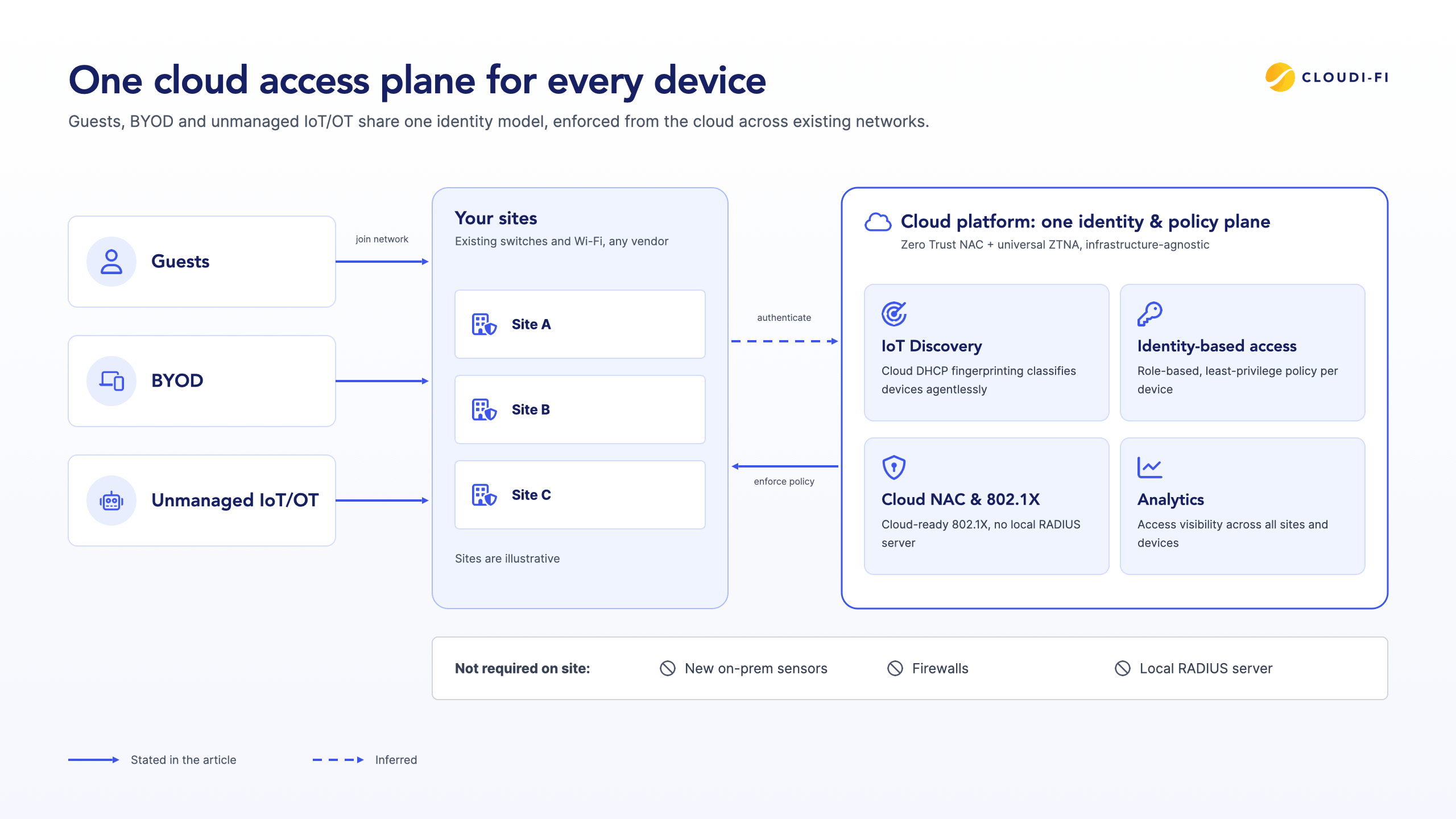
The practical question is how to deliver that control for every device type. Cloudi-Fi treats access control as a cloud service covering guests, bring-your-own-device (BYOD), and unmanaged IoT/OT under one identity model, an approach that combines Zero Trust NAC and universal ZTNA.
How to apply least-privilege access to unmanaged IoT devices
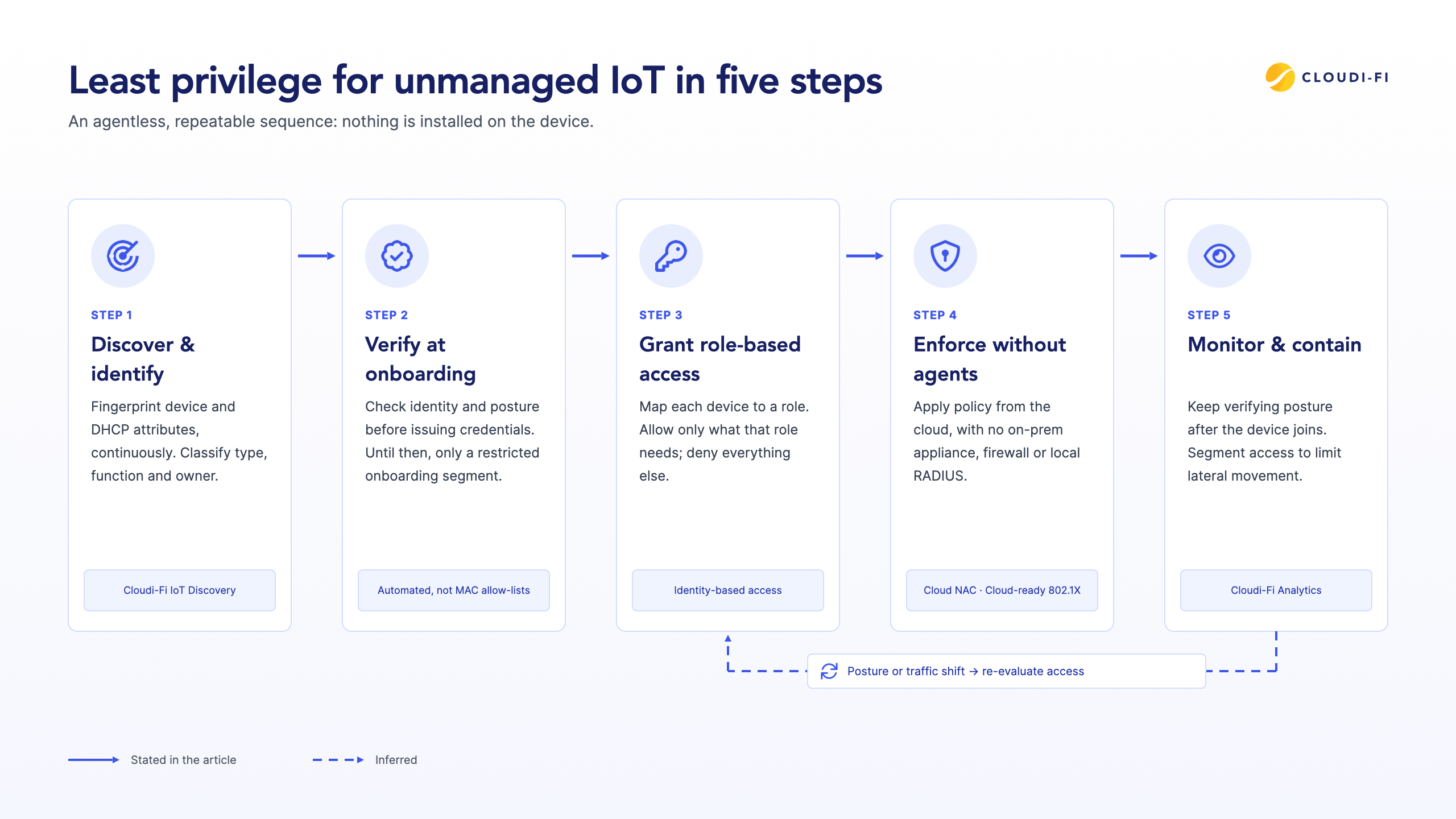
Least privilege for unmanaged devices follows a repeatable sequence. See the device, confirm its identity, grant only the access its role needs, enforce that policy, and keep watching. The five steps below turn that principle into an operating model you can run at scale, without agents on the devices.
1. Discover and identify every device
You can't grant least privilege to a device you can't see. Start with complete, continuous discovery and classification of everything on the network. Unmanaged devices can't self-report, so identify them by fingerprinting their device and Dynamic Host Configuration Protocol (DHCP) attributes.
Discovery has to be continuous, not a one-time scan. IoT fleets churn as sensors, cameras, and contractors' gear join and leave, and a device you miss is a policy gap. Classification should capture device type, function, and owner, because later policy decisions depend on that context.
Cloudi-Fi IoT Discovery uses Cloud DHCP fingerprinting to discover and classify unmanaged IoT/OT devices agentlessly. That gives you visibility into every device that requests an address.
2. Verify identity and posture at onboarding
Establish trust before issuing network credentials, not after. NIST's practice guide on trusted IoT device network-layer onboarding recommends attesting and verifying the identity and posture of both the device and the network first. Treat it as guidance, not a mandate.
The same guidance favors scalable, automated onboarding over manual MAC address allow-lists. Allow-lists don't hold up across hundreds of sites and offer no posture check. Verifying at onboarding narrows the window where a spoofed device could inherit trust it never earned.
For unmanaged devices, posture is simpler than on a laptop but still meaningful. It can mean confirming the device is the type it claims to be and matches a known fingerprint. That check runs before the device gets anything beyond a restricted onboarding segment.
3. Grant only the access each device's role needs
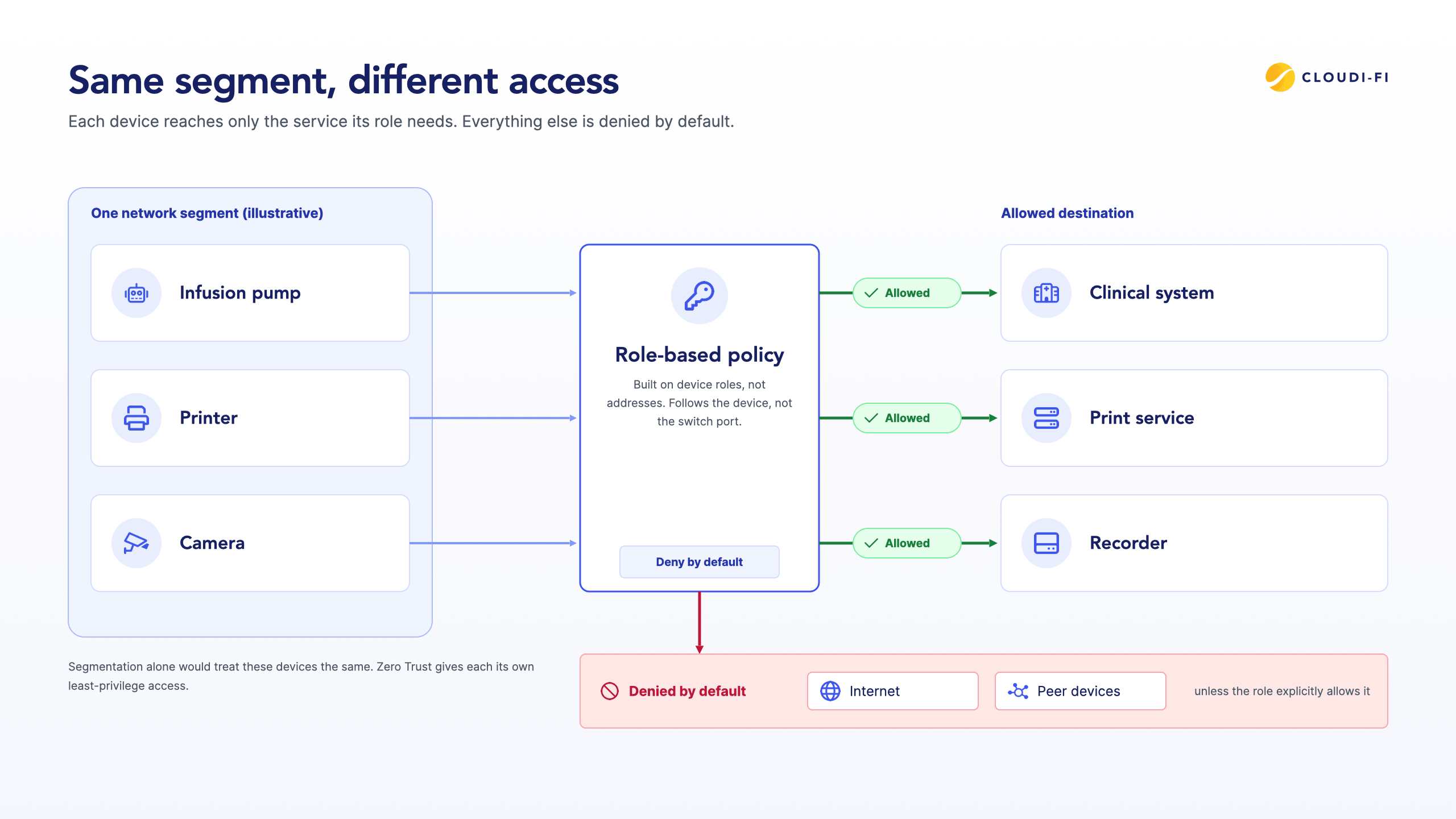
Turn identity into policy. Map each device to a role, then grant the minimum access that role requires. Deny everything else by default and allow exceptions deliberately.
Build policy around roles, not individual addresses, which keeps policy readable as the fleet grows. An infusion pump reaches its clinical system, a printer reaches its print service, and a camera reaches its recorder. Each is blocked from the internet and from peer devices unless its role explicitly allows it.
Cloudi-Fi applies identity-based access and Zero Trust enforcement without additional hardware. Policy follows the device rather than the switch port, so access stays consistent as devices move.
4. Enforce without agents or extra hardware
Enforcement is where many Zero Trust projects stall. Traditional network access control (NAC) ties policy to on-prem appliances, firewalls, or a local Remote Authentication Dial-In User Service (RADIUS) server. That is impractical across hundreds of sites, and nothing in NIST's architecture-agnostic model requires it.
Cloudi-Fi delivers enforcement through cloud NAC and Cloud-ready 802.1X, with identity-based authentication that runs without local RADIUS. The platform is infrastructure-agnostic and works across existing network vendors, so teams replacing legacy on-prem NAC can scale policy without new appliances.
5. Monitor continuously and contain the blast radius
Zero Trust doesn't stop at connection. Keep verifying posture after a device joins, and segment access to limit lateral movement. Apply just-enough access to minimize the blast radius if a device is compromised.
Continuous verification matters because a device that was trustworthy at onboarding can drift. It may change behavior, move, or be physically swapped. Treat a shift in posture or traffic pattern as a signal to re-evaluate access.
The National Security Agency (NSA) and Cybersecurity and Infrastructure Security Agency (CISA) report a related risk. Weak segmentation lets an attacker who compromises one resource move laterally across systems uncontested.
Cloudi-Fi Analytics provides network access visibility across all sites and devices. You can see what each device is doing and tighten policy over time.
Best practices and common pitfalls
A few patterns separate durable Zero Trust for IoT from checkbox projects.
- Move beyond static controls: a single "IoT VLAN" or MAC allow-list groups devices together and isn't true least privilege.
- Change default credentials first: NSA and CISA found them to be the most common misconfiguration across more than 1,000 assessed networks.
- Unify your access model: put guests, BYOD, and IoT/OT on one identity and policy plane instead of separate tools.
- Design for scale early: plan for multi-site, multi-country deployment and data sovereignty from the first rollout.
- Set expectations honestly: Zero Trust reduces risk and limits lateral movement, but it is not a breach-prevention guarantee.
Context matters for operational technology. In 2026 guidance, CISA and federal partners caution that applying blanket IT-style Zero Trust to operational technology is "neither reasonable nor feasible." Adapt the principles to constrained devices instead.
Cloudi-Fi runs this model across 90+ countries and 100K+ secured sites, serving 500M+ users and devices, with data sovereignty built into the architecture. Measure progress by how much you narrow access over time and how little any single device can reach. A practical starting point is the Zero Trust checklist for network access control.
Frequently asked questions
What is Zero Trust for IoT?
Zero Trust for IoT applies the never-trust principle to devices that can't defend themselves. Following NIST's framing, no IoT device is trusted by default; each is verified and given only the least-privilege access its function requires.
How do you apply least-privilege access to unmanaged devices?
Identify the device first, verify its identity and posture before issuing credentials, then grant role-based access and deny everything else. The sequence matters more than any single tool, because visibility enables verification and verification enables precise policy.
Can you do Zero Trust for IoT without agents?
Yes. Agentless fingerprinting classifies devices that can't run software, and cloud enforcement applies policy without an on-device client.
How is Zero Trust for IoT different from network segmentation?
Segmentation is one control inside Zero Trust, not a replacement for it. Zero Trust adds per-device identity, posture verification, and least-privilege decisions, so two devices in the same segment can still receive different access.
How do you onboard IoT and OT devices securely?
Verify the device's identity and posture before issuing network credentials, using automated network-layer onboarding rather than manual allow-lists. NIST's SP 1800-36 practice guide demonstrates this approach on commercial equipment.
Conclusion
Zero Trust for IoT comes down to three moves: identify every unmanaged device, verify it, and grant least-privilege access that you enforce continuously. The agentless devices that break traditional tools are exactly the ones this model is built to handle.
The difference is in delivery. You can apply identity-first, least-privilege access cloud-natively, without new on-prem hardware, consistently across every site and country. That keeps policy uniform whether you secure one campus or thousands of locations worldwide.
Ready to see it on your network? Get a quote.