
NIS2 Article 21 sets the minimum cybersecurity risk-management measures that essential and important entities must take across the European Union. It lists ten measures, and it does not mention network access control by name. Security teams still need to know how a control such as 802.1X, a captive portal, or device profiling fits against each measure.
This guide maps network access control (NAC) to each of the ten measures in Article 21(2). It shows where NAC contributes directly, where it contributes in part, and where it does not apply, so that security and compliance teams can scope their work with accurate expectations.
Quick answer
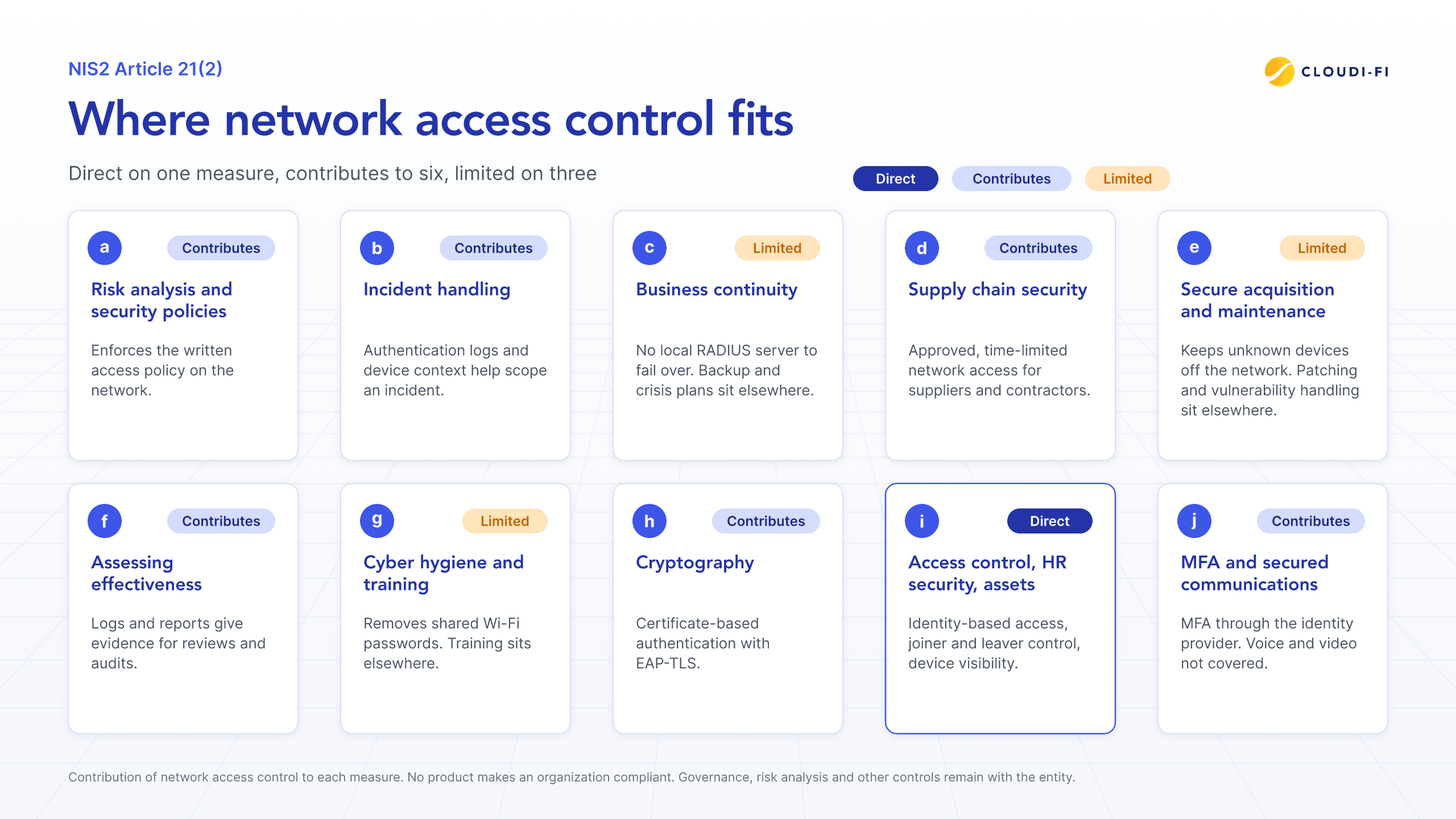
Network access control contributes to seven of the ten measures in NIS2 Article 21(2). It addresses point (i), access control and asset management, directly. It contributes in part to points (a), (b), (d), (f), (h), and (j). It has limited relevance to points (c), (e), and (g). No product makes an organization NIS2 compliant, because Article 21 sets a standard of risk management and governance, not a list of tools.
Key takeaways
- Article 21(2) lists ten minimum measures, from risk analysis to multi-factor authentication.
- NAC is the strongest fit for point (i), which covers access control, human resources security, and asset management.
- NAC supports six more measures with identity checks, segmentation, and logs, but it does not replace risk analysis, incident response, or supplier assessment.
- Three measures, business continuity, secure maintenance, and cyber hygiene training, sit mostly outside NAC.
- Auditors look for evidence. Authentication logs, policy configuration, and an administrator audit trail are the records NAC can provide.
What does NIS2 Article 21 require?
Article 21(1) requires essential and important entities to take "appropriate and proportionate technical, operational and organisational measures" to manage the risks to the security of their network and information systems. The measures must also prevent or limit the impact of incidents. Proportionality depends on the entity's exposure to risk, its size, and the likelihood and severity of incidents.
Article 21(2) requires an all-hazards approach and lists ten measures that must be included at least:
- (a) Policies on risk analysis and information system security
- (b) Incident handling
- (c) Business continuity, such as backup management and disaster recovery, and crisis management
- (d) Supply chain security, including relationships with direct suppliers and service providers
- (e) Security in the acquisition, development, and maintenance of systems, including vulnerability handling and disclosure
- (f) Policies and procedures to assess the effectiveness of cybersecurity risk-management measures
- (g) Basic cyber hygiene practices and cybersecurity training
- (h) Policies and procedures on the use of cryptography and, where appropriate, encryption
- (i) Human resources security, access control policies, and asset management
- (j) The use of multi-factor authentication or continuous authentication solutions, secured voice, video, and text communications, and secured emergency communication systems, where appropriate
Three other provisions shape how entities read the list. Under Article 21(3), entities must consider the vulnerabilities of each direct supplier and the quality of its security practices. Under Article 21(4), an entity that finds it does not comply must take corrective measures without undue delay. Under Article 20, the management body must approve and oversee the measures, and its members can be held accountable for infringements.
The stakes are concrete. Under Article 34, Member States must set maximum administrative fines of at least €10 million or 2% of worldwide annual turnover for essential entities, and at least €7 million or 1.4% for important entities, whichever is higher. Article 23 adds a reporting sequence for significant incidents, with an early warning within 24 hours, an incident notification within 72 hours, and a final report within one month of the incident notification. The full text is on EUR-Lex.
NIS2 is a directive, so national law decides the details. Timing, scope, and supervision differ by country, and organizations should check the rules of each Member State where they operate.
What is network access control, and does NIS2 mention it?
Network access control decides which users and devices may join a network and what they may reach once connected. It verifies identity, often with 802.1X and RADIUS (Remote Authentication Dial-In User Service), and then allows, limits, quarantines, or blocks access. The guide to network access control explains the mechanics.
Article 21 is technology neutral. It names no product category, and it does not require 802.1X. The more detailed rules are more concrete. Commission Implementing Regulation (EU) 2024/2690 sets technical requirements for specific entity types, such as DNS providers, cloud computing providers, data centre providers, managed service providers, and trust service providers. Its network security requirements include allowing access to systems, where appropriate, only to devices that the entity has authorised, and allowing service provider connections only after an authorisation request and for a set time period. Its segmentation requirements ask entities to divide systems into zones based on their risk assessment.
Those rules bind only the entity types they name. The European Union Agency for Cybersecurity (ENISA) published technical implementation guidance in June 2025, with examples of evidence for each requirement. Other entities can use it as a reference for what a reasonable measure looks like.
How does network access control map to each Article 21 measure?
The mapping below is an editorial assessment, not a regulatory classification. Direct means the measure names the control that NAC provides. Contributes means NAC supplies part of what the measure asks for. Limited means NAC touches the measure only at the edges.
Point (a), risk analysis and security policies
A policy matters only when it reaches the network. NAC turns a written rule, such as contractors reaching only the systems they need, into an enforced decision at the switch or access point. The risk analysis and the policy documents stay with the entity. NAC supplies the enforcement and the proof that the rule is applied.
Point (b), incident handling
During an incident, teams need to know which user and device connected, where, and when. NAC records those authentication events. Administrators can assign a quarantine profile to a rogue or unidentified device, which limits its reach while the investigation runs. NAC does not detect threats or run the response. That work belongs to a security operations team and tools such as a security information and event management (SIEM) system. The 24-hour and 72-hour reporting deadlines in Article 23 make quick access to this evidence valuable.
Point (c), business continuity and crisis management
NAC is relevant to continuity in one narrow way. A cloud NAC removes the local RADIUS servers that otherwise need high-availability pairs, disaster recovery nodes, and regular tests. It also adds a dependency on a cloud service, which the continuity plan should record. Backup management, disaster recovery, and crisis management remain outside NAC.
Point (d), supply chain security
NAC contributes to third-party network access. Contractors and maintenance providers can register through a sponsored process, where an employee approves the request, and receive access suited to their role for a limited time. This matches the Implementing Regulation's expectation that service provider connections happen only after an authorisation request and for a set time period.
Two limits apply. Supplier risk assessment and contracts sit outside NAC. The NAC provider is also a supplier, and Article 21(3) expects the entity to assess its security practices like any other.
Point (e), secure acquisition, development, and maintenance
NAC does not scan for vulnerabilities or manage patches. It contributes at the edges. Unknown and unmanaged devices stay out of production segments until they are identified. Where a mobile device management (MDM) tool, such as Microsoft Intune, distributes the certificates, network access follows device management. Centrally managed NAC upgrades also remove per-site maintenance windows for the access layer.
Point (f), assessing the effectiveness of measures
NAC supplies data for the review. It records authentication successes and failures, which users and devices connected, which policy applied, and which changes administrators made in the console. ENISA's guidance lists logs from authentication systems among the evidence for secure authentication. The assessment programme itself, including audits and testing, belongs to the entity.
Point (g), cyber hygiene and training
NAC trains no one. It supports one hygiene practice, which is the removal of shared Wi-Fi passwords. Each employee, contractor, or guest signs in with an individual identity or a registered session instead. Awareness programmes, phishing exercises, and management body training sit outside NAC.
Point (h), cryptography
Certificate-based 802.1X, typically with Extensible Authentication Protocol-Transport Layer Security (EAP-TLS), authenticates devices with cryptographic credentials instead of shared secrets. NAC does not set an organization's encryption policy or manage data-at-rest encryption. Where certificates are used, issuance and revocation need a clear owner. The article on PKI built into cloud NAC covers that lifecycle.
Point (i), human resources security, access control, and asset management
This is the core fit. NAC establishes who or what is connecting and applies the matching access, using virtual LAN (VLAN) assignment, roles, and access control lists (ACLs) for employees, contractors, and devices. With a directory such as Microsoft Entra ID or Active Directory behind the policy, a disabled account fails its next authentication, and a re-authentication interval limits how long an existing session stays open, so joiner, mover, and leaver changes reach the network.
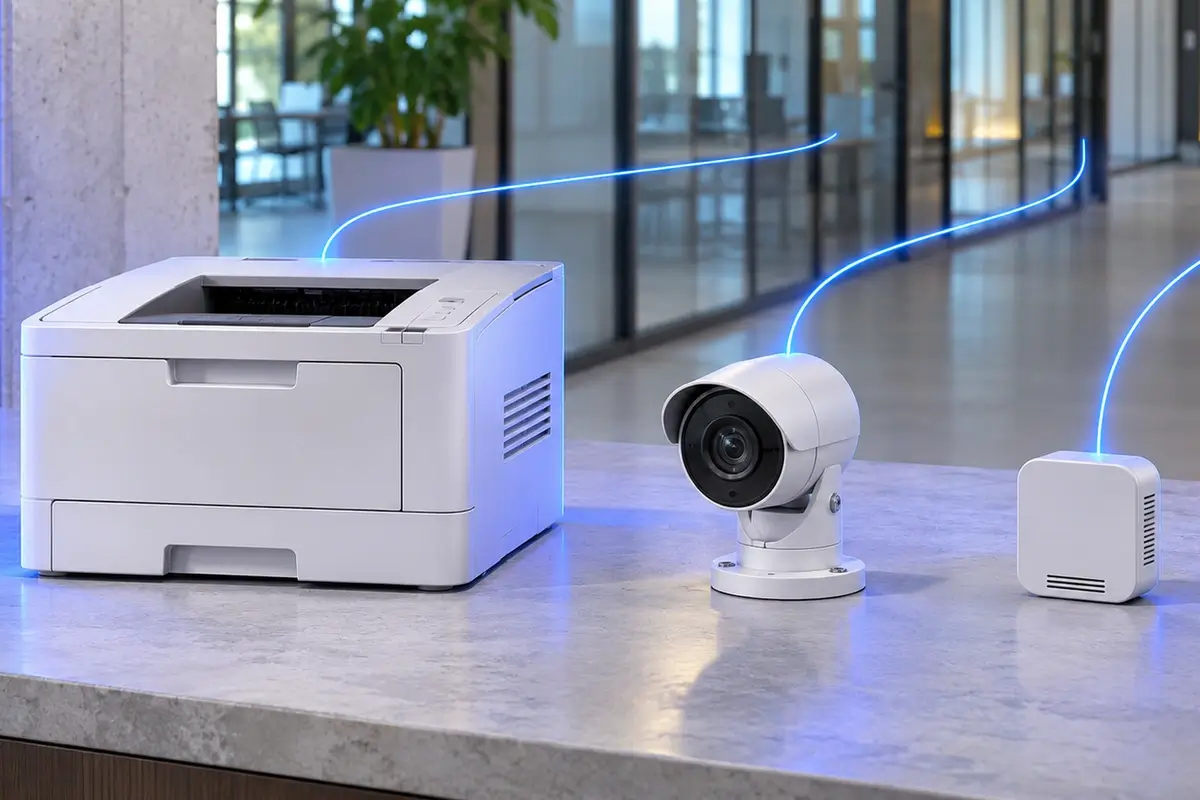
Asset management depends on knowing what is connected. DHCP fingerprinting classifies printers, cameras, and sensors by type, operating system, and manufacturer, which feeds the asset inventory that ENISA's guidance describes. Classification is not identity. Access to sensitive systems should rely on stronger credentials than a device profile.
Point (j), multi-factor authentication and secured communications
NAC contributes to the first item of point (j). For web-based sign-in, such as the corporate access portal and the NAC console, single sign-on with SAML hands the sign-in to the organization's identity provider, which can enforce multi-factor authentication (MFA) for people who use corporate access and for administrators of the NAC console. Certificate-based authentication gives a strong device credential, but on its own it is not a second factor for a person. Secured voice, video, text, and emergency communications fall outside NAC.
What evidence can network access control give an Article 21 audit?
Article 21 sets a standard of care. Entities must be able to show that measures exist, fit the risk, and work. ENISA's guidance gives examples of evidence for each requirement, and several map to NAC records:
- An access control policy that states which populations get which access, matched to the policy configuration in the NAC.
- Logs from the authentication system showing successful and failed attempts.
- Evidence of the systems that enforce access control, such as the NAC and the switches and access points that apply its decisions.
- A device inventory with classification and a history of changes.
- An administrator audit trail covering logins, account changes, and configuration changes.
Retention and access to these records should follow applicable law and the organization's own policy. Where logs hold personal data, the Wi-Fi GDPR obligations apply as well, as the guide to Wi-Fi GDPR compliance explains.
What does network access control not cover?
NAC is one layer. It does not perform risk analysis, backup and recovery, crisis management, supplier assessment, vulnerability scanning, or staff training. It is not a firewall, an endpoint detection tool, or a SIEM. It cannot run incident response or file the incident reports that Article 23 requires. It enforces decisions only through compatible switches, access points, controllers, and firewalls. The management body remains responsible for approving and overseeing the whole programme.
Stating these limits in the compliance file is part of doing the mapping well. A reviewer is more likely to trust a document that says what a control does not do.
How can organizations use NAC in an Article 21 programme?
A practical sequence has five steps.
1. List the populations on each site, such as employees, contractors, guests, personal devices, and IoT equipment.
2. Write an access policy for each population and link it to the risk assessment under point (a).
3. Choose an authentication method for each population. Certificates suit managed devices, directory credentials suit employees, sponsor approval suits contractors, and MAC authentication with isolation suits devices that cannot run 802.1X.
4. Enforce and segment through the existing switches, access points, and controllers, using VLANs, roles, and ACLs, with quarantine for unknown devices.
5. Keep the logs, set retention to legal requirements, connect them to the SIEM where one is used, and review them at planned intervals under point (f).
For a wider rollout plan, the Zero Trust checklist for NAC implementation breaks the work into steps for IT teams.
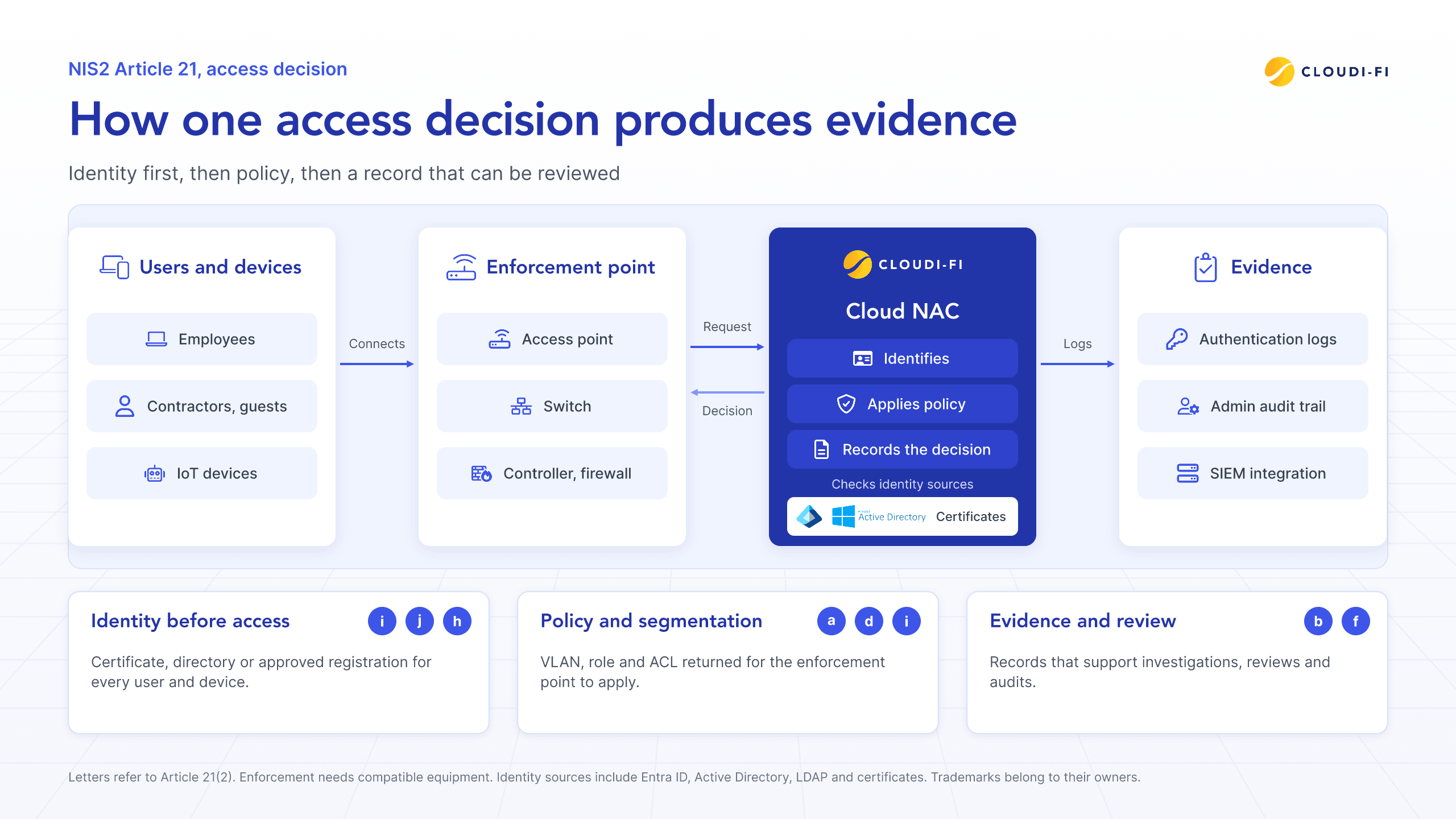
The diagram shows the same sequence in a cloud NAC. The decision happens in the cloud service, the existing network equipment enforces it, and the record supports points (b) and (f).
How does Cloudi-Fi support Article 21 requirements?
Cloudi-Fi contributes selected technical controls to a wider compliance program. Cloud NAC authenticates employees and managed devices with certificates or directory credentials and returns VLAN, role, or ACL attributes to the existing network. The Cloud Captive Portal onboards visitors, contractors, and personal devices through sponsor approval, SMS, email, social login, or corporate sign-in. IoT fingerprinting classifies connected equipment, and Cloud DHCP gives visibility of leases across sites.
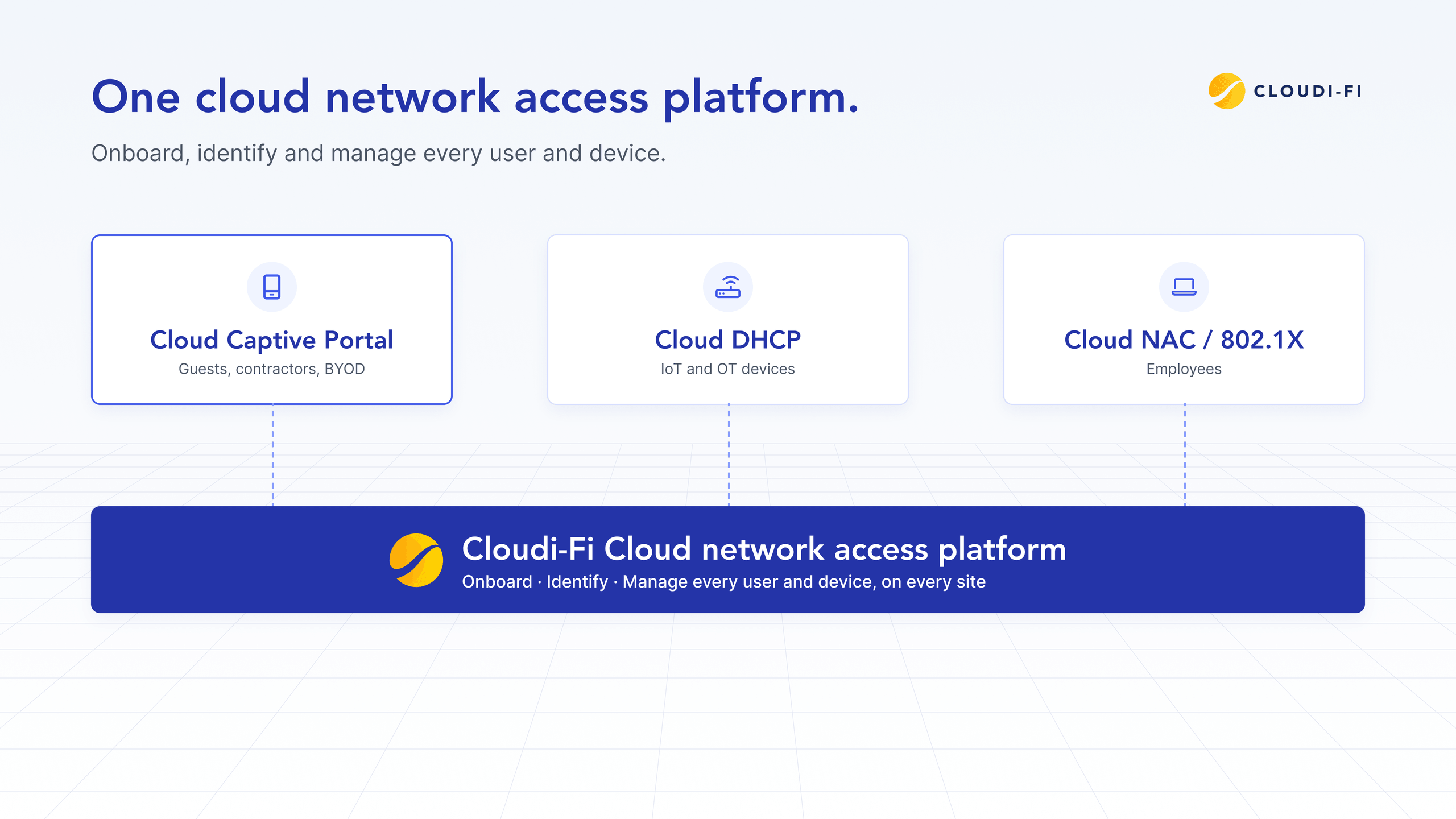
These services run from one console with one set of logs, and they work with the switches, access points, and firewalls that organizations already run. Enforcement depends on compatible equipment, and log retention and SIEM integration depend on how each deployment is configured. A deployment is not certified by the platform alone. The Cloudi-Fi Help Center article on NIS2 compliance and network access describes the supported controls in more detail.
The Cloudi-Fi Help Center article on NIS2 compliance and network access describes the supported controls in more detail.
Frequently asked questions
What does NIS2 Article 21 require?
Article 21 requires essential and important entities to take appropriate and proportionate technical, operational, and organisational measures to manage cybersecurity risks. It lists ten minimum measures, from risk analysis and incident handling to access control and multi-factor authentication, and it asks for an all-hazards approach.
Does network access control make an organization NIS2 compliant?
No. NAC contributes to several Article 21 measures, mainly access control, authentication, and evidence. Compliance also needs governance, risk analysis, incident handling, continuity, supplier oversight, and training.
Is multi-factor authentication mandatory under NIS2?
Article 21(2)(j) lists the use of multi-factor authentication or continuous authentication solutions, where appropriate. Entities decide where it applies based on their risk assessment, and national rules or implementing acts may be more specific.
Does NIS2 require 802.1X?
No. Article 21 is technology neutral and names no protocol. 802.1X is one established way to authenticate users and devices before they reach the network, and it can support the access control and authentication measures.
Who must comply with NIS2 Article 21?
Essential and important entities in the sectors that the directive lists must comply. Medium-sized and large entities in those sectors generally fall within scope, with exceptions. National law decides the details, so organizations should check the rules and the competent authority in each country where they operate.
What are the penalties for not meeting Article 21?
Article 34 requires Member States to set maximum administrative fines of at least €10 million or 2% of worldwide annual turnover for essential entities, and at least €7 million or 1.4% for important entities, whichever is higher. Supervisory authorities also have other powers, which national law defines.