
Many multi-site enterprises authenticate Wi-Fi and wired users through on-premise Remote Authentication Dial-In User Service (RADIUS) servers. These include Microsoft Network Policy Server (NPS), FreeRADIUS, and appliance-based network access control (NAC), often deployed per site or region. This use case covers the move from legacy RADIUS to cloud RADIUS with Cloudi-Fi Cloud NAC, and the migration workflow IT teams follow.
Problem
Server lifecycle and hardware refresh
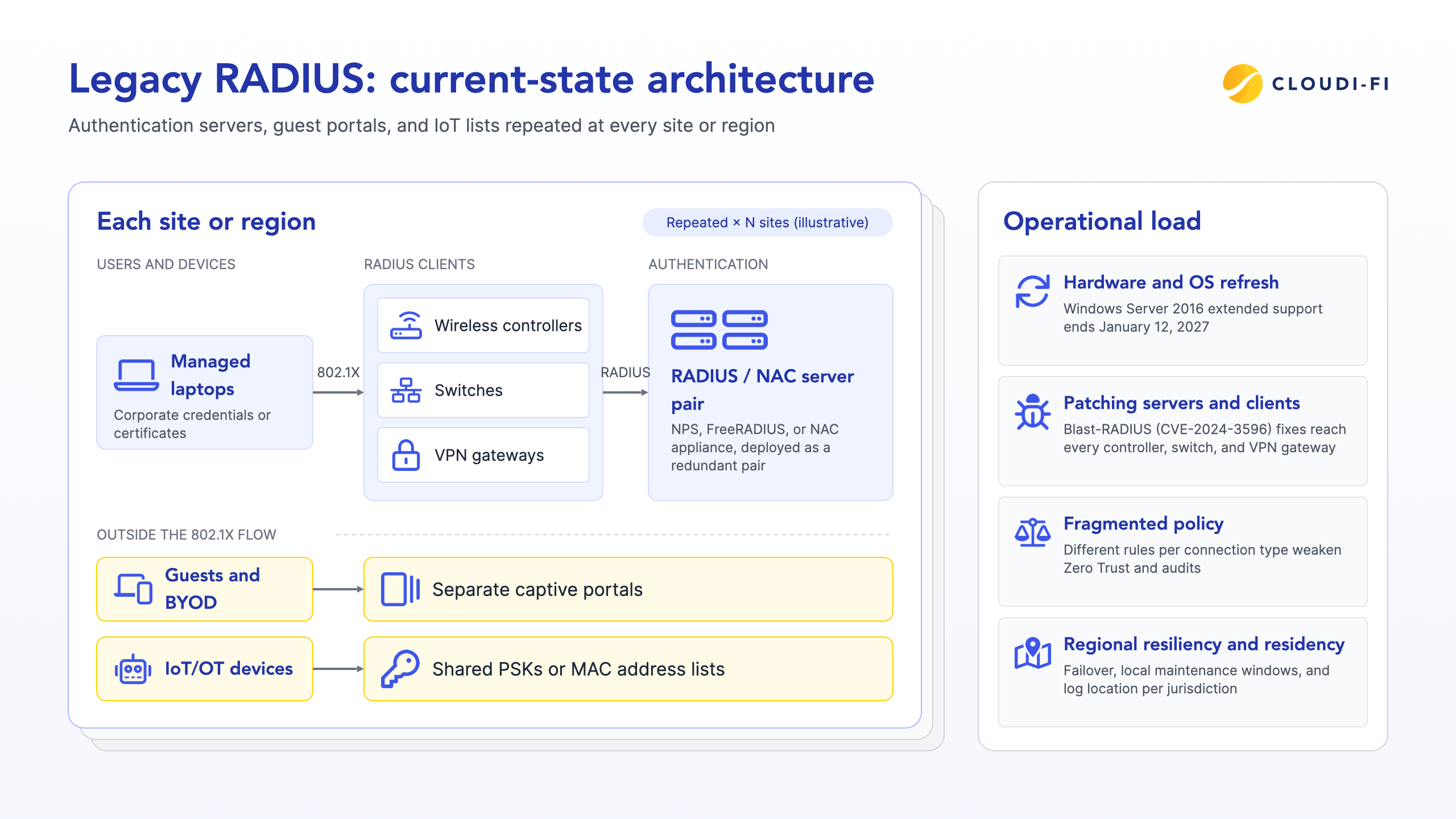
Each site or region running legacy RADIUS needs at least one server, usually deployed as a redundant pair for availability. Hardware fails and must be replaced, configured, and tested. Microsoft described the same pattern in its own previous on-premise NAC, noting that all hardware fails eventually.
Operating system lifecycles add a second refresh cycle. Windows Server 2016, a common NPS host, reaches end of extended support on January 12, 2027, according to Microsoft. Organizations that stay on it can buy paid Extended Security Updates through Azure Arc, which Microsoft announced in February 2026.
Either path requires planning at every site that hosts an authentication server.
Patching across every server and client
In July 2024, researchers disclosed Blast-RADIUS, tracked as CVE-2024-3596. It is a protocol-level flaw in RADIUS over User Datagram Protocol (UDP). It lets an on-path attacker forge an Access-Accept response for non-EAP (Extensible Authentication Protocol) authentication flows.
The fix reaches beyond the server. The FreeRADIUS project states that operators must update all RADIUS servers and all RADIUS clients. RADIUS clients include wireless controllers, switches, and virtual private network (VPN) gateways at every site.
Patches also carry outage risk. Microsoft's July 2024 NPS security update caused RADIUS authentication failures for clients that did not send the Message-Authenticator attribute. The Blast-RADIUS researchers add that RADIUS over Transport Layer Security (TLS), their long-term mitigation, requires public key infrastructure and may be unsupported on older hardware.
Each patch cycle needs coordinated testing and maintenance windows across servers and network devices.
Fragmented policy for users, guests, and IoT
802.1X authentication works for managed laptops with corporate credentials or certificates. Guests, bring your own device (BYOD) users, and Internet of Things and operational technology (IoT/OT) devices often sit outside that flow. They connect through separate captive portals, shared pre-shared keys (PSKs), or media access control (MAC) address lists.
The device population keeps growing. IoT Analytics counted about 18.5 billion connected IoT devices globally in 2024 and forecasts 39 billion by 2030. These are global counts across all IoT connections and do not measure enterprise networks.
When policy is split across tools, each connection type follows different rules. That split weakens Zero Trust, which calls for identity-based decisions on every connection. It also makes audits harder to run consistently across sites.
Multi-region resiliency and compliance
Multi-region enterprises plan failover between authentication servers in each region. Maintenance windows must align with local business hours, which differ by country. Microsoft listed a lack of regional resiliency among the limits of its previous on-premise NAC.
Data residency requirements also vary by jurisdiction. Authentication logs and user data may need to stay within specific countries or regions. For teams running servers in many countries, each requirement adds configuration, documentation, and audit work.
How Cloudi-Fi fits into a cloud RADIUS migration
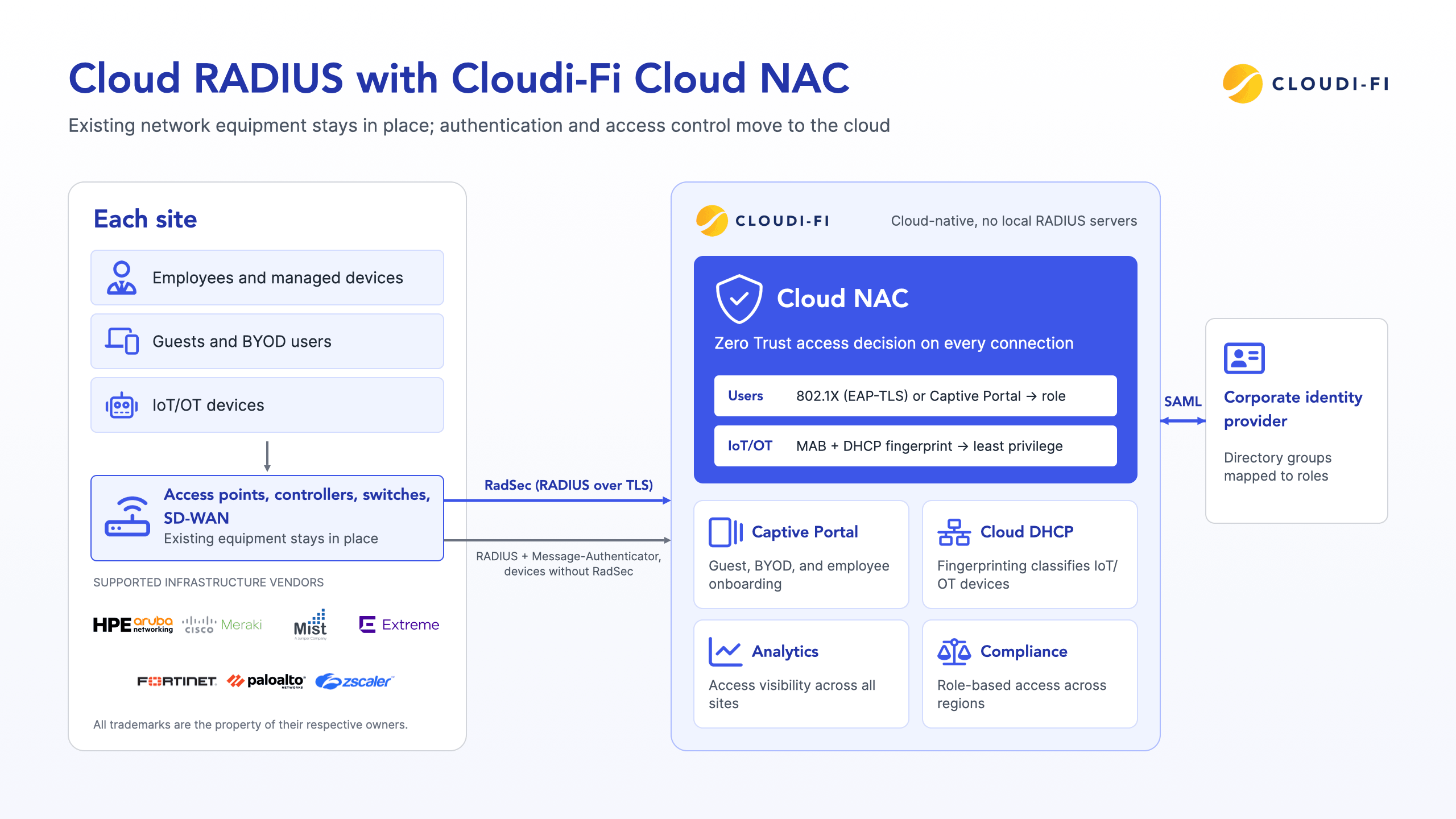
Cloudi-Fi Cloud NAC fits into the existing network as a cloud-native authentication and access control layer. The platform is infrastructure-agnostic and replaces legacy on-premise NAC without local RADIUS or additional hardware.
Architecture
Each Cloudi-Fi component maps to a function of the legacy stack:
- Cloud NAC: Cloud-based NAC unified with Zero Trust Network Access (ZTNA) identity provider capabilities, with no local RADIUS servers
- Captive Portal: Guest, BYOD, and employee Wi-Fi onboarding through Security Assertion Markup Language (SAML), corporate identity providers, social logins, and custom forms
- Cloud DHCP: Dynamic Host Configuration Protocol (DHCP) fingerprinting to identify and classify unmanaged IoT/OT devices, so each device class can be assigned a role
- Zero Trust security: An access decision for every connection. Users authenticate through 802.1X or Captive Portal; devices that can't authenticate are identified by profiling and given restricted access
- Analytics: Network access visibility across all sites and devices, showing what connects, where, and how access is controlled
- Compliance: Role-based access built for governance requirements across sites and regions
Cloudi-Fi integrates with physical and cloud infrastructure, so organizations roll it out using their existing infrastructure provider. Access points, controllers, and software-defined wide area network (SD-WAN) equipment stay in place.
RADIUS traffic from each site reaches Cloudi-Fi over RadSec (RADIUS over TLS), the long-term mitigation the Blast-RADIUS researchers recommend. TLS encrypts and integrity-protects every exchange between the access point or controller and the cloud. Network devices without RadSec support connect over standard RADIUS using the Message-Authenticator attribute, the interim Blast-RADIUS mitigation. Both are standards-based, so they work across infrastructure vendors.
Supported infrastructure vendors include HPE Aruba Networking, Cisco Meraki, Juniper Mist, Extreme Networks, Fortinet, Palo Alto Networks, and Zscaler.
Migration workflow
A cloud RADIUS migration runs in stages so legacy servers stay available until each site is validated:
- Inventory: List every RADIUS client, service set identifier (SSID), policy, certificate dependency, and IoT device group at each site.
- Connect identity: Link the corporate identity provider and map directory groups to roles. SAML handles Captive Portal sign-in for guests, BYOD users, and employees.
- Move 802.1X authentication: Move each SSID and wired port to certificate-based EAP-TLS, using Cloudi-Fi Cloud PKI or the organization's existing certificate authority. Intune or certificate attributes can drive role assignment.
- Pilot one site: Point one site's RADIUS clients, or a pilot SSID, at Cloudi-Fi with legacy servers online. Confirm employee, guest, and device access.
- Run in parallel: Keep legacy RADIUS as a fallback and compare access results in Cloudi-Fi Analytics.
- Migrate in waves: Move sites region by region and automate controller configuration where possible. Review each wave before starting the next.
- Onboard guests and IoT: Move guest and BYOD access to Captive Portal and profile IoT/OT devices with Cloud DHCP fingerprinting.
- Decommission: Retire legacy servers and redundant pairs after a defined stable period with no fallback events.
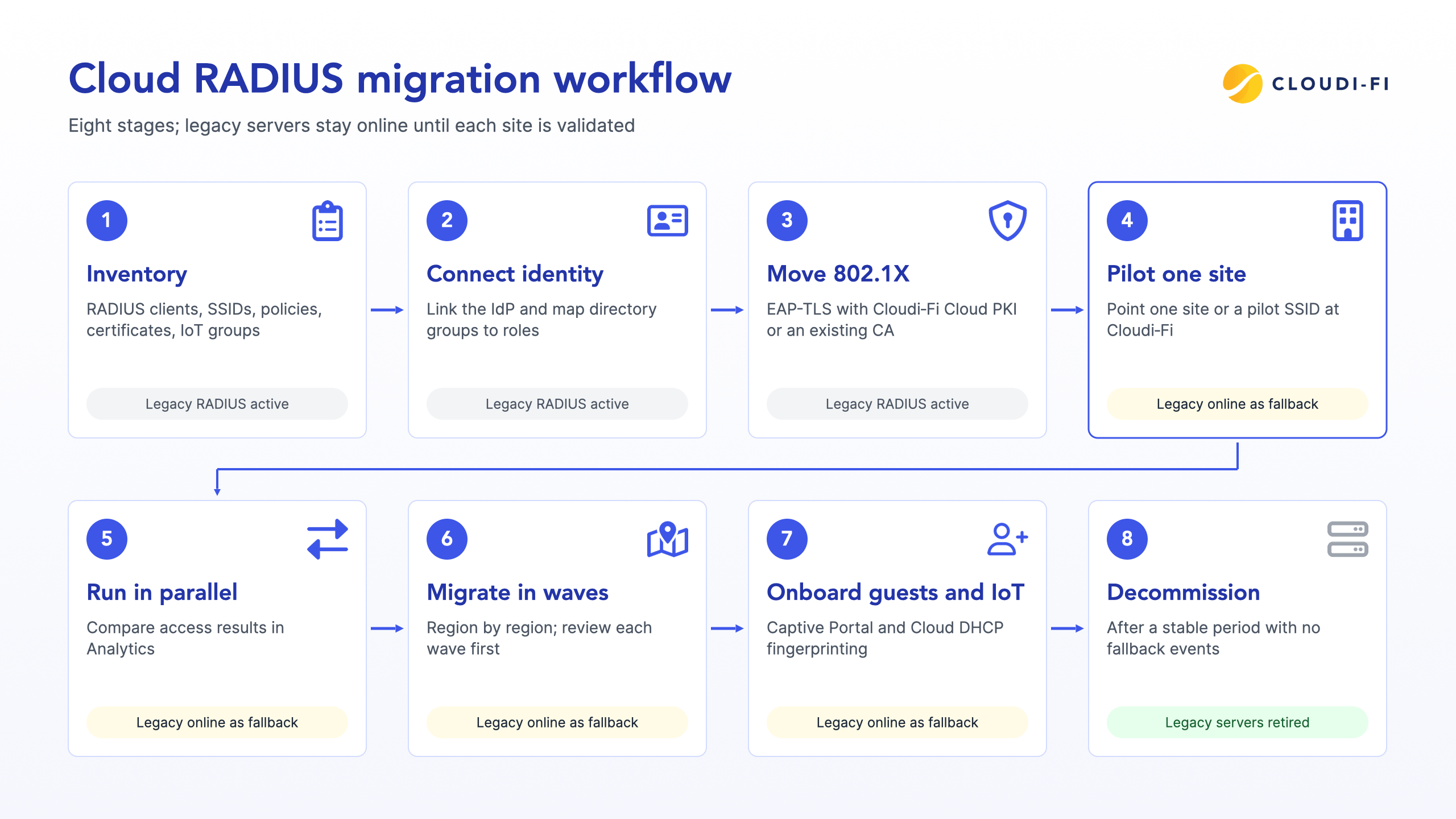
Steps 4 and 5 keep the legacy path online until the cloud RADIUS path is validated. That sequencing limits outage risk during cutover. Step 8 happens only after every site runs on Cloudi-Fi.
Microsoft documented a similar phased pattern for its guest Wi-Fi NAC. It moved that service from on-premise hardware to self-managed virtual machines hosted on Azure. The team ran old and new services in parallel and migrated building by building.
According to Microsoft, an Ansible playbook evaluated configuration on 900 wireless controllers. It applied updates only where the existing configuration was standard, after validating RADIUS connectivity to the new servers. This sequencing maps onto steps 4 to 6 above.
Zero Trust alignment
NIST (National Institute of Standards and Technology) SP 800-207 states that network location alone does not imply trust. It describes access granted per session, with policy components that may run on-premise or as a cloud-based service. NIST also treats Zero Trust migration as incremental.
Cloudi-Fi applies an access decision to every connection before granting access. Users and managed devices authenticate through 802.1X or the Captive Portal. IoT/OT devices that can't run 802.1X are identified by MAC authentication bypass (MAB) and DHCP fingerprint, then placed in a least-privilege role. Profiling identifies a device, but it doesn't prove the device is genuine.
Outcome
Once the migration completes, authentication runs from a cloud-native service instead of local server rooms. Each change below maps to a problem described above: server lifecycle, patching, fragmented policy, and regional compliance.
The operational changes follow from retiring self-managed RADIUS and NAC infrastructure in favor of cloud RADIUS:
- No on-site RADIUS servers or redundant pairs to buy, patch, or refresh
- No operating system end-of-support migrations for authentication hosts
- No server-side RADIUS patch cycles scheduled site by site
- One policy model for employees, guests, BYOD users, and IoT/OT devices across sites
- Network access visibility across all sites and devices in Analytics
Cloudi-Fi supports this model at global scale: 90+ countries, 500M+ users and devices, and 100K+ secured sites. The platform is trusted by 200+ enterprises worldwide.
No neutral benchmark quantifies the total cost of ownership (TCO) change from retiring on-premise RADIUS. As an outside reference, Microsoft reported that its Azure-hosted NAC saved hundreds of engineering hours, a self-reported figure for its guest Wi-Fi environment. Results depend on site count, server footprint, and patch cadence.