
Acquisitions leave enterprises running guest Wi-Fi on several vendors, each with its own portal, policies and connection logs. Multi-vendor guest Wi-Fi can be standardized by adding one cloud-based captive portal layer above existing controllers, without replacing the acquired company's hardware. This use case describes the integration problem IT teams inherit and the workflow Cloudi-Fi fits into.
Problem
Global mergers and acquisitions (M&A) deal value rose 40% to $4.9 trillion in 2025, according to Bain & Company's Global M&A Report 2026. Each deal brings an acquired network estate, and guest Wi-Fi is one visible, customer-facing integration workstream.
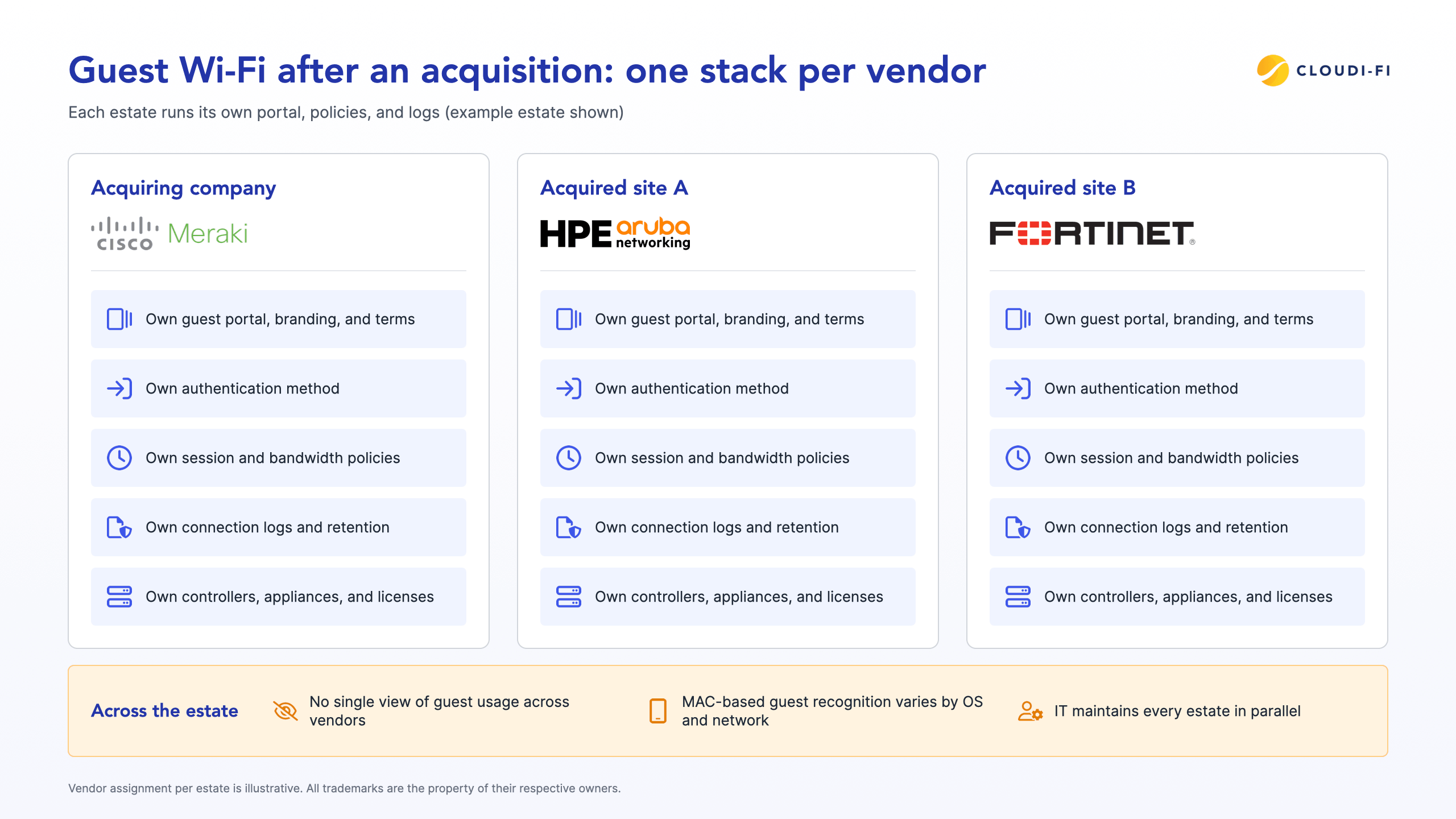
A post-acquisition estate typically combines several vendors. The acquiring company may run Cisco Meraki, while acquired sites run HPE Aruba Networking, Fortinet, Cisco Wireless LAN Controllers (WLC) or Juniper Mist. Each vendor's native guest portal is configured, branded and maintained separately.
The result is fragmentation at every layer of the guest experience:
- Branding and terms of use: Each site presents a different portal and different legal text.
- Authentication: Methods range from open service set identifiers (SSIDs) to shared passwords and sponsor approval.
- Policies: Session duration and bandwidth limits differ from site to site.
- Visibility: No single view of guest usage exists across vendors.
Compliance fragments in the same way. Connection logs sit in different systems with different retention periods. Article 5(1)(e) of the General Data Protection Regulation (GDPR) limits storage to what is necessary, but sets no fixed retention period.
National rules add specific obligations, such as those of France's Commission nationale de l'informatique et des libertés (CNIL). In France, according to CNIL, organizations offering public internet access must keep technical connection data for 1 year. This applies to visitor Wi-Fi in offices, and CNIL also requires public Wi-Fi to be separated from the internal network.
Inherited identity methods behave inconsistently too. Android 10 and later use a randomized media access control (MAC) address by default, persistent per network. Apple iOS 14 and later use private Wi-Fi addresses, and from iOS 18 the default on captive portal and open networks is a rotating address.
Setups that rely on MAC allowlists or MAC-based guest recognition therefore produce different results by operating system and network type. Each estate also carries its own on-premise controllers, portal appliances and licenses. IT maintains all of them in parallel.
How Cloudi-Fi fits into multi-vendor guest Wi-Fi
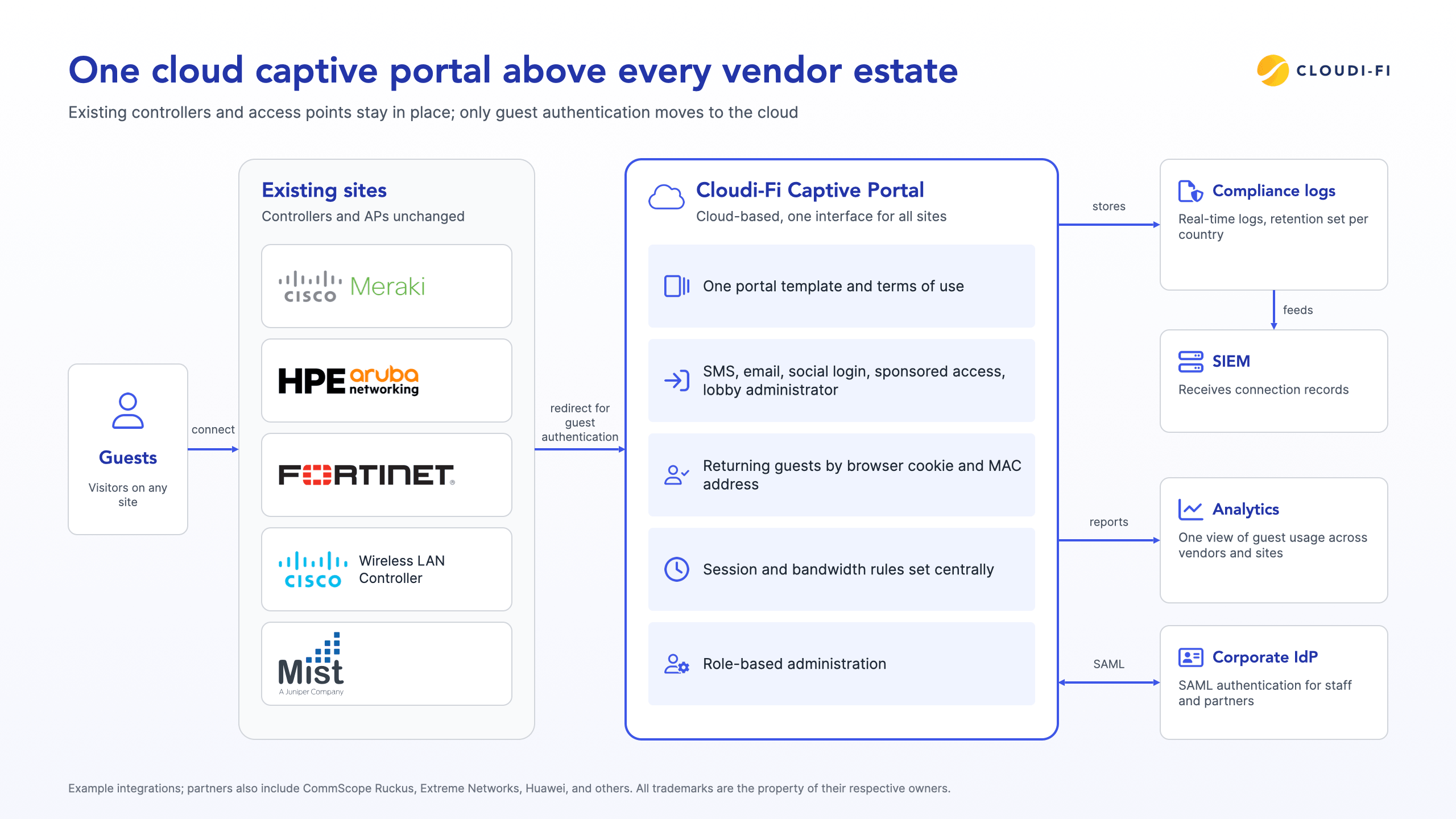
Cloudi-Fi is a cloud-native, infrastructure-agnostic network access platform. The Cloudi-Fi Captive Portal sits above existing controllers and access points from multiple vendors, with no new hardware on site. Integration partners include Cisco, Cisco Meraki, HPE Aruba Networking, Fortinet, Juniper Mist and CommScope Ruckus.
The partner list also covers Extreme Networks, Huawei, Alcatel-Lucent, Palo Alto Networks, Versa Networks and Zscaler. One platform serves heterogeneous technology platforms and vendors.
Connect each vendor estate to one captive portal
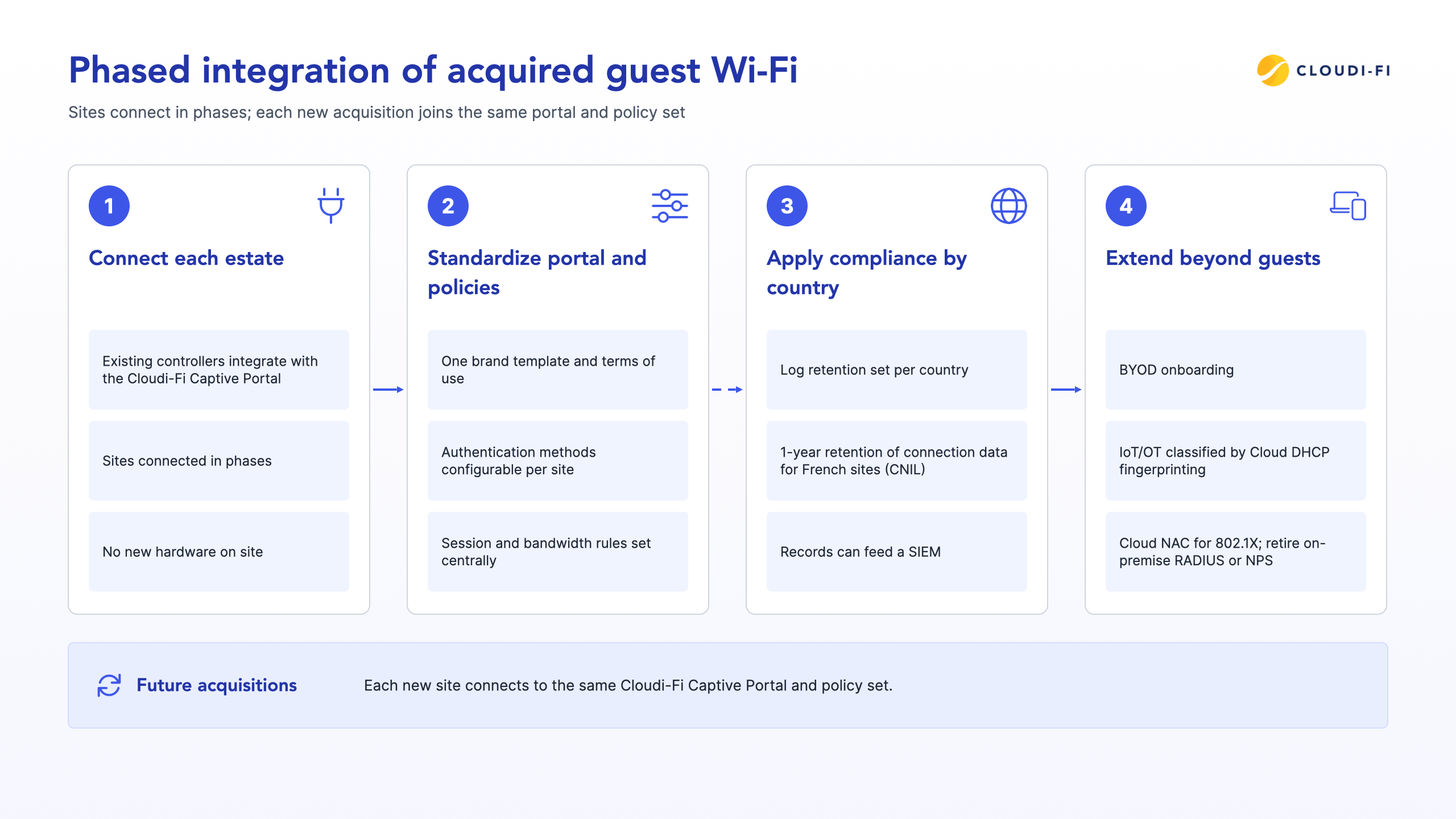
Each site's existing controller integrates with the Cloudi-Fi Captive Portal for guest authentication. This applies to Cisco Meraki, HPE Aruba Networking, Fortinet, Cisco WLC and the other supported vendors. No on-premise controllers or captive portal appliances are added.
Integration teams can connect sites in phases, following Cloudi-Fi's plug-and-play deployment model, which uses each site's existing infrastructure provider.
The acquired company's access points and controllers stay in place. Only the guest authentication layer moves to the cloud.
Standardize portal, authentication and policies
Once each site redirects guests to one portal, guest Wi-Fi management moves to a single interface. Policies, authentication methods, access rules and usage visibility are defined there for all sites and infrastructures.
- Portal and terms of use: One brand template and one set of terms apply across sites.
- Guest authentication: Methods are configurable per site, including text message (SMS), email, social login, sponsored access and lobby administrator.
- Returning guests: Cloudi-Fi recognizes returning guests by browser cookie as well as by MAC address, where applicable, so recognition doesn't rely on MAC addresses alone.
- Corporate identity: Security Assertion Markup Language (SAML) and corporate identity providers authenticate staff and partners.
- Access policies: Session duration and bandwidth rules are set centrally and applied to every connected site.
- Administration: Role-based access and customizable administrator profiles define what each administrator can manage.
Apply compliance by country
Cloudi-Fi Compliance stores connection logs with retention periods set per country, matching local requirements in over 100 countries. Logs are available in real time, with compliance-ready data retention. Records can feed a security information and event management (SIEM) system.
Data sovereignty is built into the architecture globally, not anchored to a single country or region. Cloudi-Fi applies authentication log retention according to each location's country setting, following local regulations. For French sites, this covers the 1-year retention of technical connection data that CNIL describes.
Retention is therefore set per country rather than per inherited vendor. Legal review of each country's requirements remains advisable.
Extend the same model beyond guests
The same platform supports bring your own device (BYOD) onboarding. Internet of Things and operational technology (IoT/OT) devices are identified and classified through Cloud DHCP (Dynamic Host Configuration Protocol) fingerprinting, so each device class can be assigned a role. Cloud NAC (Network Access Control) handles 802.1X authentication without local Remote Authentication Dial-In User Service (RADIUS) servers.
Integration teams can retire on-premise RADIUS or NAC in a later phase. A Fortune 500 insurer with 500+ agencies applied this model across Cisco WLC, Cisco Meraki and Aruba controllers. Cloudi-Fi connected to the existing controllers without new hardware and replaced the on-premise Network Policy Server (NPS).
Outcome
Once acquired and legacy sites run through the Cloudi-Fi Captive Portal, the integration produces these operational outcomes:
- Guests see one portal experience and one set of terms of use across acquired and legacy sites.
- Existing Wi-Fi hardware stays in place, with no captive portal appliances or on-premise controllers added.
- Policy updates apply across sites from one interface. The Fortune 500 insurer cut policy deployment time from days to hours.
- Log retention periods are set per country from one platform, matching local requirements in over 90 countries.
- Real-time connection logs are available for audit across acquired and legacy sites.
- Guest authentication uses the same configured methods, such as SMS, email or SAML, at every site.
- Analytics provides a single view of guest usage across all vendors and sites.
Cloudi-Fi is trusted by 200+ enterprises worldwide. The platform operates across 90+ countries, covering 500M+ users and devices and 100K+ secured sites.
The same outcomes extend to future acquisitions, since each new site connects to the same Cloudi-Fi Captive Portal and policy set.
Check infrastructure compatibility
Check your infrastructure compatibility, then get Cloudi-Fi to standardize guest access across every acquired site.