

Every guest who connects to your Wi-Fi and enters an email address is handing you personal data and with it, a legal obligation. Under GDPR, that simple login screen becomes a compliance checkpoint where consent, transparency, and data protection all converge.
This guide covers what makes Wi-Fi GDPR-compliant, the role of captive portals in meeting legal requirements, authentication method trade-offs, and how to scale compliant guest access across global networks.
What Wi-Fi GDPR compliance means for businesses
Wi-Fi GDPR compliance comes down to a few core requirements: obtaining explicit, informed consent before collecting user data via captive portals, displaying clear privacy notices, and providing users with a way to exercise their rights. Marketing consent can't be a condition for network access, checkboxes can’t be pre-ticked, and all collected data must be handled securely with defined retention periods.
Here's the thing: any Wi-Fi network that collects personal data from users in the EU or EEA triggers GDPR obligations. And "personal data" covers more than you might expect. It includes obvious identifiers like email addresses and names, but also device-level data such as MAC addresses, connection timestamps, and browsing logs, which can be used to identify a person, directly or indirectly, relative to others.
The business operating the Wi-Fi network is what GDPR calls the "data controller." That means you're legally accountable for why and how data is collected, stored, and used. Even if your headquarters is outside Europe, GDPR applies the moment you process data of someone physically located in the EU.
Why non-compliant Wi-Fi creates legal and financial risk
Supervisory authorities across Europe actively audit and penalize organizations that fail to meet GDPR requirements. Beyond regulatory fines, non-compliance exposes businesses to reputational damage that erodes customer trust; sometimes permanently.
Investigations also consume significant internal resources. Legal teams, IT staff, and compliance officers can spend months responding to regulatory inquiries, wasting time and budget that could be directed elsewhere.
How GDPR applies to guest and corporate Wi-Fi
Not only guest Wi-Fi falls squarely within GDPR scope when personal data is collected during the connection process, but corporate Wi-Fi for employees, contractors, and BYOD users is equally in scope.
The distinction matters less than the underlying principle: if you're processing personal data, GDPR applies. Both network types require consent capture, privacy notices, and documented retention policies.
The role of the captive portal in GDPR compliance
A captive portal is the login screen that users see before gaining network access. It's the gateway where compliance begins, since authentication, consent capture, and logging all happen here.
Cloud-based captive portals centralize these functions across all locations, making it far easier to maintain consistent compliance at scale. Platforms like Cloudi-Fi deploy a single portal configuration globally, which eliminates the inconsistencies that come with site-by-site management.

Secure user authentication
Authentication verifies user identity before granting access. Methods range from simple email verification to SAML-based single sign-on with corporate identity providers.
The authentication step creates the audit trail required by the GDPR, linking a specific user to a specific session at a specific time.
Consent capture and management
Consent capture happens before data collection begins. Users see granular opt-in checkboxes that should never be pre-ticked and that separate network access from optional activities like marketing communications.
Withdrawing consent has to be as easy as giving it. A clear unsubscribe link or portal-based preference center satisfies this requirement.
Legal traceability and logging
Connection logs link user identity to network activity, supporting both GDPR accountability and local data retention laws. Some jurisdictions, like the UK under the Investigatory Powers Act, mandate minimum retention periods for security purposes.
These logs become critical during audits or legal inquiries, demonstrating exactly who accessed the network and when.
Want to see how your Wi-Fi captive portal measures up? Request the Worldwide Guest Wi-Fi Compliance Report to evaluate your network's compliance and security posture. Get the Worldwide Guest Wi-Fi Compliance Report
Core legal requirements for GDPR-compliant Wi-Fi
This section covers the primary compliance checklist: what businesses actually do to meet GDPR obligations on Wi-Fi networks.
Lawful basis and explicit consent
Every data processing activity requires a "lawful basis," which is the legal justification for processing data. For Wi-Fi networks, consent is typically the appropriate basis where users agree to data collection in exchange for network access.
Valid consent is:
- Freely given: Users aren't forced or pressured
- Specific: Tied to a particular purpose, all the reasons for the processing must be clearly stated
- Informed: Users know what they're agreeing to
- Unambiguous: No room for confusion about what's being consented to, explicit and given via a positive act. It uses clear and plain language and is clearly visible
- Withdrawal: It’s possible to withdraw consent
Bundling marketing consent with terms of service doesn't meet this standard.
Transparency and privacy notices
Users receive clear information about what data is collected, why it's collected, how long it's retained, their rights, and with whom it's shared. This privacy notice appears before or at the point of data collection, not buried in a link at the bottom of the page.
Purpose limitation
Data collected for network access cannot be repurposed for marketing without separate consent. If you told users you're collecting their email for authentication, that's the only purpose you can use it for.
Data subject rights
GDPR grants users specific rights over their data, for example, access, erasure, and portability. The dedicated section below covers implementation details.
Choosing a GDPR-compliant Wi-Fi authentication method
Click-through terms acceptance
This is the simplest method. The users accept terms without providing personal details. Traceability is limited, and there's no marketing value, but compliance overhead is minimal.
Email and SMS authentication
Users provide contact information that's verified via email link or SMS code. This creates better audit trails and enables re-marketing with separate consent.
Social login
Users authenticate via Facebook, Google, LinkedIn, or similar providers. Data is pulled from the social provider, so your privacy notice covers this third-party data flow. The consent complexity is higher because you're dealing with data from an external source.
SAML and corporate SSO
SAML (Security Assertion Markup Language) integrates with corporate identity providers such as Azure AD and Okta. This works best for employee and contractor Wi-Fi when an existing relationship is identified, simplifying the consent process.
Designing a GDPR-compliant captive portal
Portal design directly affects compliance. A well-designed portal makes consent clear and privacy information accessible.
Clear privacy information
The privacy notice is visible, easy to read, and accessible before the user submits any data. Plain language works better than legal jargon for both users and regulators.
Granular opt-in consent
Separate checkboxes for different processing purposes keep consent clean and compliant:
- I agree to the terms of service (required for access)
- I consent to receive marketing communications (optional)
Pre-ticked boxes are not compliant. Each consent is independent.
Accessibility and multilingual support
Portals are accessible to users with disabilities and available in relevant languages for your user base. Cloudi-Fi supports multi-language portals for global deployments across 90+ countries.
Data minimization for Wi-Fi user data
Data minimization means collecting only what's necessary for the stated purpose. For Wi-Fi, this typically breaks down as follows:
- Collect: Email or phone for authentication, device MAC for session management
- Avoid: Full name, address, demographic data unless specifically needed
The less data you collect, the smaller your compliance footprint.
Wi-Fi connection log retention rules
GDPR requires data not to be kept longer than necessary. However, some jurisdictions mandate minimum retention periods for security or law enforcement purposes, which creates a balancing act.
Automated deletion policies eliminate the risk of human error. Cloudi-Fi's platform includes configurable retention rules that automatically delete data on schedule.
Supporting data subject rights on Wi-Fi networks
GDPR grants users specific rights, and businesses have processes to fulfill requests within required timeframes, typically 30 days.
Right to access
Users can request a copy of all data held about them. This typically means exporting their records from the captive portal system in a readable format.
Right to erasure
Users can request the deletion of their data, often referred to as the "right to be forgotten." Exceptions exist for legal retention requirements, but the default is deletion after the data are no longer necessary.
Right to withdraw consent
Users can withdraw consent at any time via a link in the portal or by submitting an email request. The key point: withdrawal is as easy as giving consent in the first place.
Right to data portability
Users can request their data in a machine-readable format, such as CSV or JSON. This is less common for Wi-Fi data but still requires support.
Infrastructure and network security requirements for GDPR
GDPR requires "appropriate technical and organizational measures" to protect data. For Wi-Fi networks, this translates to several practical requirements:
- Encryption: Data in transit and at rest is encrypted
- Access controls: Limit who can access user data internally
- Network segmentation: Separate guest Wi-Fi from corporate networks
- Secure authentication: Use WPA3 or WPA2-Enterprise where possible
Cloudi-Fi's Zero Trust security model and cloud-based infrastructure eliminate on-prem vulnerabilities while enforcing these protections globally.
Documentation and audit records for Wi-Fi compliance
GDPR's accountability principle requires documented evidence of compliance. You can't just be compliant; you have to prove it.
Key documentation includes:
- Records of processing activities (ROPA): What data is processed, why, by whom, and the recipients to whom the data will be disclosed
- Consent records: Timestamped proof of user consent to demonstrate that the users have consented to the processing when the processing is based on consent
- Data protection impact assessments (DPIA): Required for high-risk processing on the rights and freedoms of users
- Data processing agreements: Required when using data processors to ensure their obligations
- Privacy Notice: inform users of the data processing to ensure the lawfulness of that process
- Technical and Organizational Measures Documentation: to demonstrate compliance with security obligations
Scaling GDPR compliance across global multi-site networks
Maintaining consistent compliance across hundreds of locations is challenging with site-by-site management. Centralized, cloud-based platforms solve this by deploying identical policies globally from a single dashboard.
Cloudi-Fi operates across 100k+ secured sites in 90+ countries, enabling consistent policy enforcement regardless of local infrastructure.
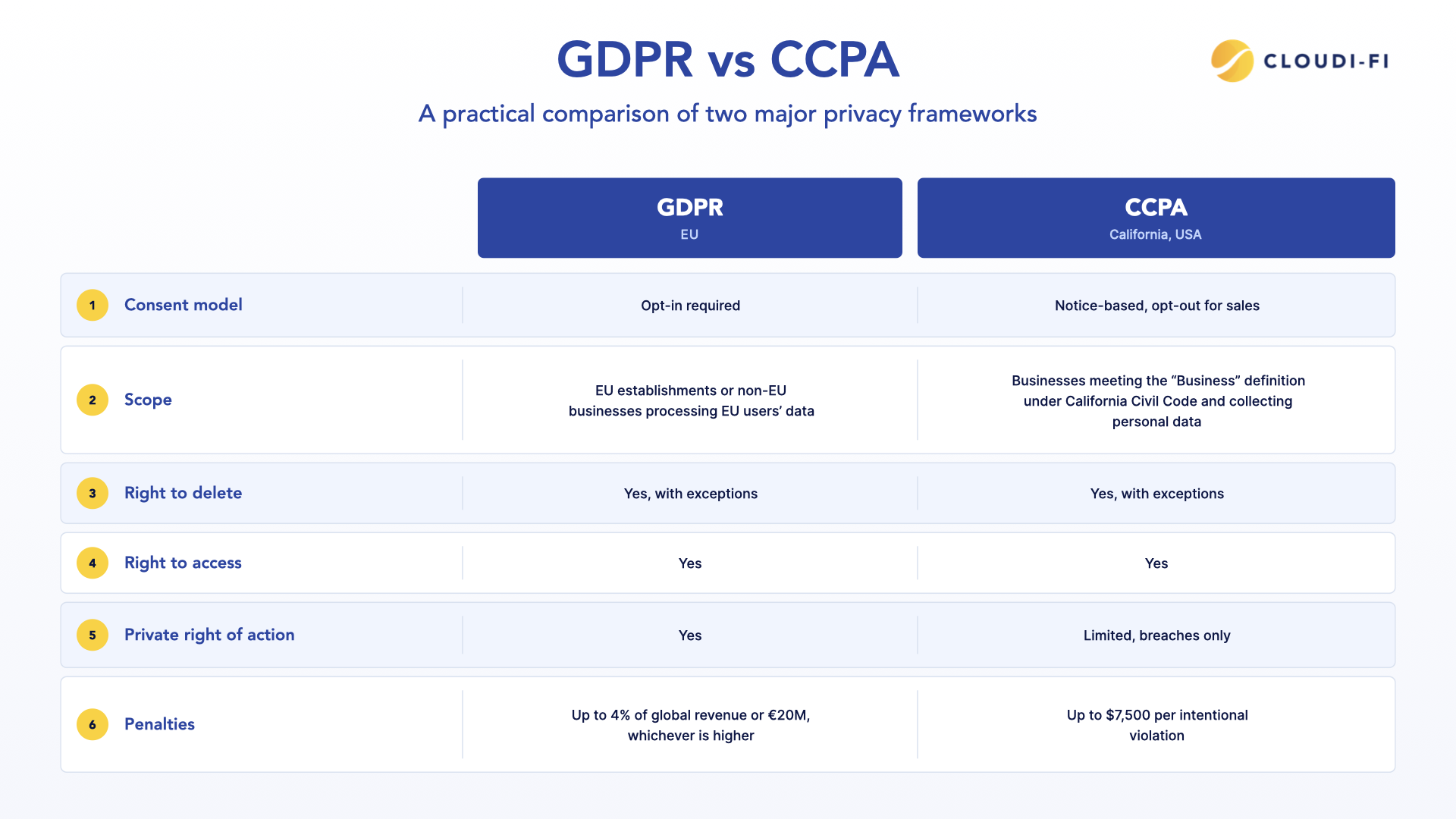
How GDPR compares to CCPA and other privacy laws
Cloudi-Fi's platform supports global compliance with region-specific policy configurations.
Common GDPR Wi-Fi compliance mistakes to avoid
- Pre-ticked consent boxes: Not valid under GDPR
- Bundled consent: Combining terms of service with marketing consent
- No retention policy: Keeping data indefinitely
- Missing privacy notice: Collecting data before informing users
- Ignoring data subject requests: Failing to respond within required timeframes
- Unsecured networks: Open Wi-Fi without encryption or authentication
Build compliant Wi-Fi at global scale with Cloudi-Fi
Cloudi-Fi's cloud-native, infrastructure-agnostic platform is trusted by 200+ enterprises including L'Oréal, Siemens, and Goldman Sachs. The platform delivers centralized compliance across 90+ countries with built-in GDPR-compliant consent capture, automated log retention, and an in-house legal team monitoring regulatory changes worldwide.
FAQ about Wi-Fi GDPR compliance
What are the penalties for non-compliant guest Wi-Fi under GDPR?
GDPR enforcement can result in significant fines scaled to the severity of the violation and the organization's revenue. Supervisory authorities also have the power to order data processing to stop entirely.
Does GDPR apply to free public Wi-Fi networks?
GDPR applies to any Wi-Fi network that collects personal data from users in the EU or EEA, regardless of whether the service is free or paid.
Can businesses offer open Wi-Fi without a captive portal and remain GDPR compliant?
Open Wi-Fi without a captive portal makes it difficult to capture consent, provide privacy notices, or maintain audit trails. A captive portal is the most practical way to meet these obligations.
How does UK GDPR differ from EU GDPR after Brexit?
UK GDPR mirrors EU GDPR in most respects, but businesses operating in both jurisdictions comply with each regulation separately. The UK has its own supervisory authority (the ICO) and may diverge further over time.
Are BYOD and IoT devices subject to Wi-Fi GDPR compliance requirements?
BYOD and IoT devices are in scope if they're associated with identifiable individuals or if their connection data constitutes personal data. Segmenting and managing these devices helps maintain compliance and reduce risk.