What the refrigeration cyberattacks reveal about unmanaged IoT
Key takeaways
- Since October 11, 2026, commercial refrigeration systems have been hit by cyberattacks in several EU Member States.
- Press reports describe controllers reachable from the internet for remote maintenance, with default passwords and outdated firmware as common weaknesses.
- These devices have no user, no agent, and usually no 802.1X, so they sit outside the controls built for laptops.
- Network-level containment limits who can reach a controller and what it can reach. It does not replace patching or password changes.
- Multi-site operators gain most from one device profile that applies at every site at once.
Since October 11, 2026, commercial refrigeration systems have been hit by cyberattacks in several EU Member States, according to a joint statement from ENISA and its EU partners. In France, attackers raised the temperature of freezers and chiller cabinets in as many as 700 stores, and tons of food had to be thrown away. The devices at the center of the incidents are not computers in the usual sense. They are controllers that a refrigeration contractor installed, that nobody logs into daily, and that stay connected so a technician can manage them remotely.
What happened
The first wave struck shortly before midnight on October 11, 2026. Hackers remotely overrode temperature settings and pushed freezers from as low as minus 27°C to well over 50°C. Food first defrosted, then began to cook, and in some stores the heat started fires, according to The Guardian's account of October 17. Chains including Intermarché, Coopérative U, Carrefour, Leclerc, and Monoprix were among the victims, along with smaller independent shops.
A second wave followed on November 1 and 2. Retailers in Belgium, Estonia, Finland, Ireland, Luxembourg, the Netherlands, and Sweden reported refrigeration problems, and food suppliers in the UK were affected. On November 4, ENISA, the European Commission, Europol's European Cybercrime Centre, the EU CSIRTs Network, and EU-CyCLONe advised organizations to take immediate action to mitigate exposure in the affected systems.
Why refrigeration controllers were an easy target
Press reports point to weaknesses that are ordinary, not exotic. Most supermarket cold aisles are connected to the internet so that contractors can maintain them and receive failure alerts. Danfoss, whose controllers were involved, said the affected units were running outdated firmware and that it had identified security flaws the year before. A security researcher quoted by The Guardian said many units appeared to run with a default password.
The attackers also appear to have prepared the ground. Initial investigations suggest they disabled alarms or extended the defrost program, so stores learned of the damage only when the first employee arrived in the morning. France's national cybersecurity agency ANSSI confirmed that stores using controllers from two other manufacturers were also targeted. The problem was a class of device, not a single product.
The UK National Cyber Security Centre said the attacks used vulnerabilities that had been "out there for a long period of time," and that they were not AI-enabled. The cyberdefense firm Lupovis recorded 256 attempted attacks from 91 sources between October 20 and 30 on decoy controllers it had placed online. Most attempts used the manufacturer's publicly documented factory-default credentials.
Why this is a network access problem
A refrigeration controller cannot run a security agent, cannot use multi-factor authentication, and usually cannot use 802.1X. Network teams tend to see it only as an IP address, if at all. Three questions decide how far an attacker can go. Is the device reachable from the internet? What else on the site network can it reach? Does anyone know it is there?
Retail and facilities operators multiply the problem. A chain with hundreds of sites has hundreds of small networks, each with few staff and several outside contractors who connect remotely. A broad firewall rule that lets a maintenance company in is hard to review when thousands of others sit beside it. It also does not say which technician is connecting to which device.
How containment narrows the path
Containment applies least privilege to devices that cannot defend themselves, the approach described in Cloudi-Fi's guide to Zero Trust for IoT. Four controls matter most.
- Identify devices. DHCP fingerprinting reads the options a device sends when it asks for an IP address, which helps infer its type, vendor, and often its operating system without an agent.
- Assign a profile. Controllers go into a restricted profile. Unknown and low-confidence devices go into quarantine until they are classified.
- Enforce through the firewall. Rules applied by IP address and profile can remove inbound access from the internet and limit a controller to the services it needs.
- Change policy at every site at once. When an advisory names a device family, one profile change replaces a site-by-site campaign.
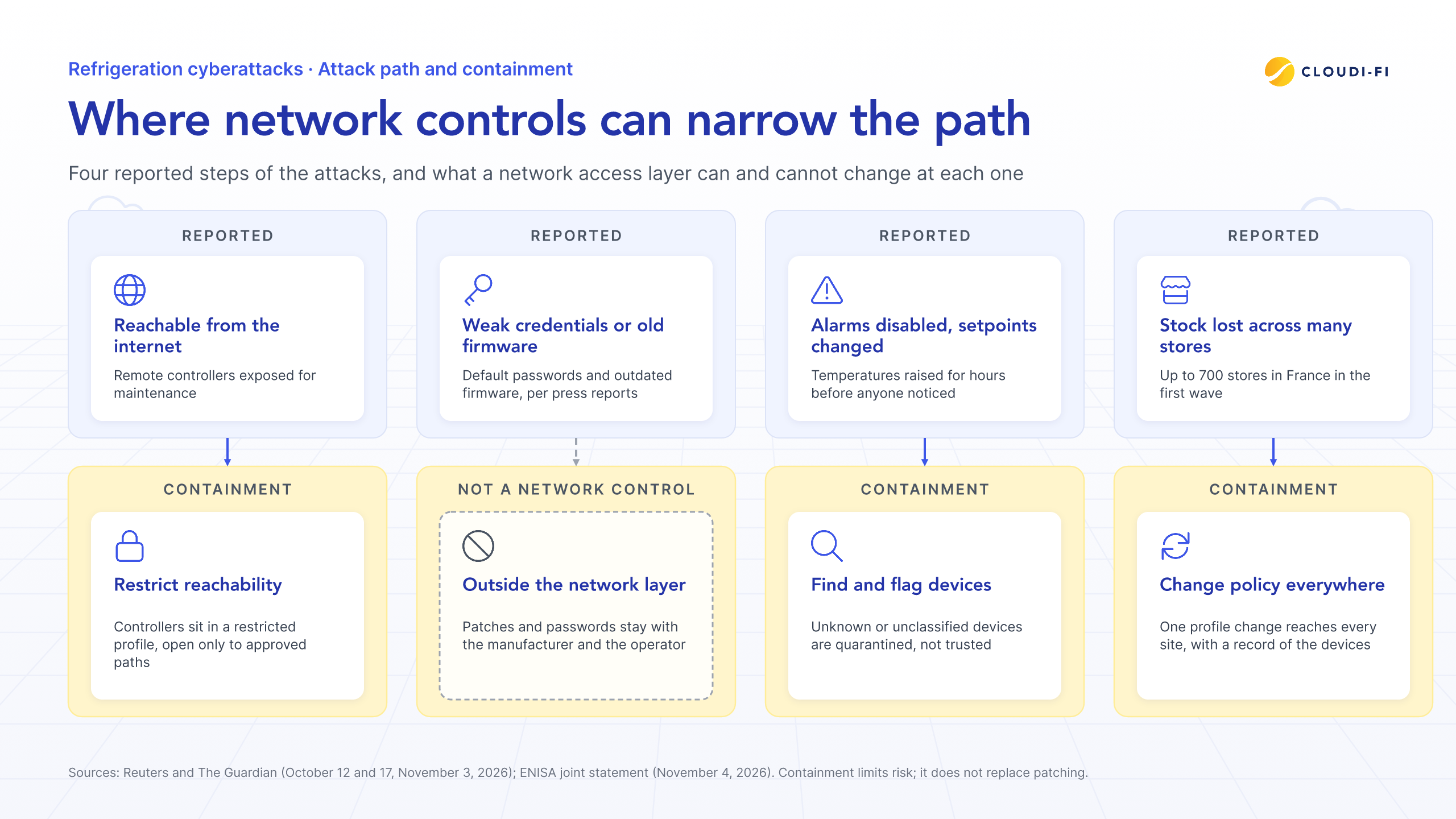
Cloudi-Fi applies this model through DHCP fingerprinting and device profiles and firewall policy automation, described in the use case multi-site IoT containment for retail and facilities. Containment has limits. It does not patch firmware, change a default password, or replace the manufacturer's updates. It also depends on classification quality. A fingerprint is a signal that a hostile device can imitate, and many embedded devices share generic stacks that produce low-confidence matches. Devices with static IP addresses never send a DHCP request and need another discovery method. These limits are why classification should lead to restriction, not to broad trust.
What retail and facilities teams can check this week
- List every refrigeration, heating, and building controller at each site, with the contractor who maintains it.
- Confirm that none is reachable directly from the internet, and review broad remote-access firewall rules.
- Replace default credentials and apply manufacturer firmware updates, or plan the replacement of unsupported units.
- Place controllers in their own segment, with outbound access limited to what the manufacturer service needs.
- Check which reporting duties apply and who owns them. ENISA notes that NIS2 entities must manage cybersecurity risks and report significant incidents to their national CSIRT, and that since September 11, 2026 manufacturers must report severe incidents and actively exploited vulnerabilities under the Cyber Resilience Act. Its main requirements apply from December 11, 2027.
Conclusion
The refrigeration attacks did not need advanced techniques. They used known weaknesses in devices that were reachable, unmonitored, and maintained by third parties. For multi-site operators, the lesson is to know every device, restrict what each can reach, and be able to change that policy everywhere from one place.
See how Cloudi-Fi identifies and contains IoT devices across every site. Request a demo.
Frequently asked questions
What caused the EU refrigeration cyberattacks?
Press reports describe remote controllers that were reachable from the internet and ran outdated firmware or default credentials. ENISA's statement does not give a technical cause, and national authorities were still investigating when it was published.
Can network segmentation stop this kind of attack?
Segmentation limits what a compromised device can reach and limits lateral movement. It does not fix a vulnerable controller, so exposure to the internet must also be removed, and updates and passwords still need attention.
Do EU rules require action from retailers?
According to ENISA, entities covered by NIS2 must manage cybersecurity risks and report significant incidents, and manufacturers of connected products must report severe incidents under the Cyber Resilience Act. Whether a specific retailer is covered is a question for its legal and compliance teams.