
Recently, a major mobile network disruption cut coverage for a large share of users in one country. Within minutes, people looked for another way online, and guest Wi-Fi became that way. Across Cloudi-Fi guest Wi-Fi deployments, connections reached almost 2.5 times the level of a regular day over the day, and more over shorter periods. The platform kept running.
That episode is a concrete reminder of a simple point. Internet access is critical, so backup connectivity matters for business continuity. And a backup is only useful if it can cope with a sudden surge in users.
When mobile coverage disappears, Wi-Fi becomes the network
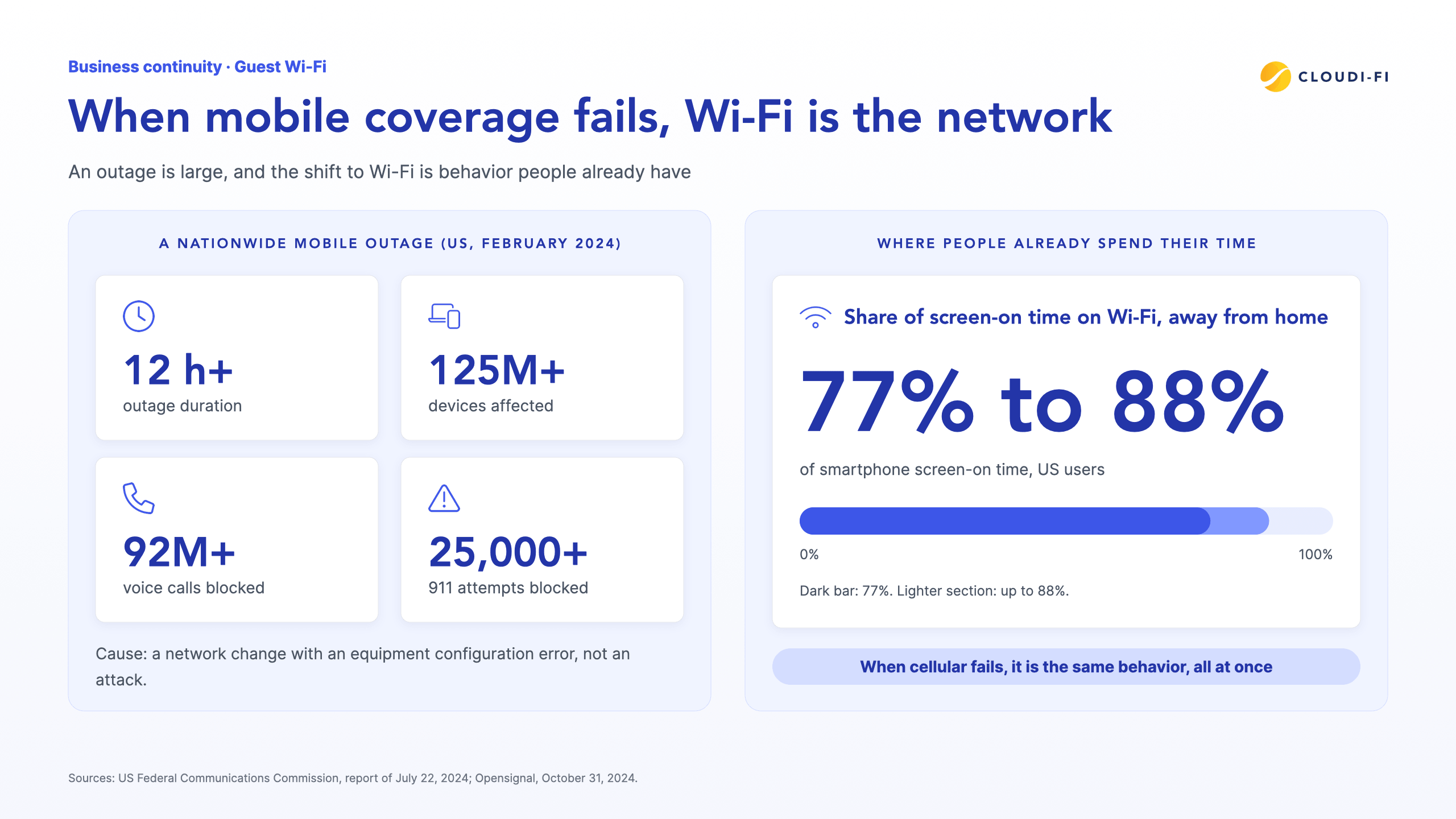
Mobile outages are rare, but they are not small. In February 2024, a nationwide wireless outage at a US operator lasted at least 12 hours. According to the US Federal Communications Commission (FCC), it affected more than 125 million devices, blocked more than 92 million voice calls, and prevented more than 25,000 attempts to reach 911 (FCC, July 22, 2024). The cause was a network change with an equipment configuration error, not an attack.
Wi-Fi is already where people spend most of their connected time. An Opensignal analysis of US smartphone users found that, even away from home, they spent 77% to 88% of their screen-on time connected to Wi-Fi (Opensignal, October 31, 2024). When cellular service fails, the shift to Wi-Fi is not a new behavior. It is the same behavior, all at once.
Why business continuity needs an isolated guest network
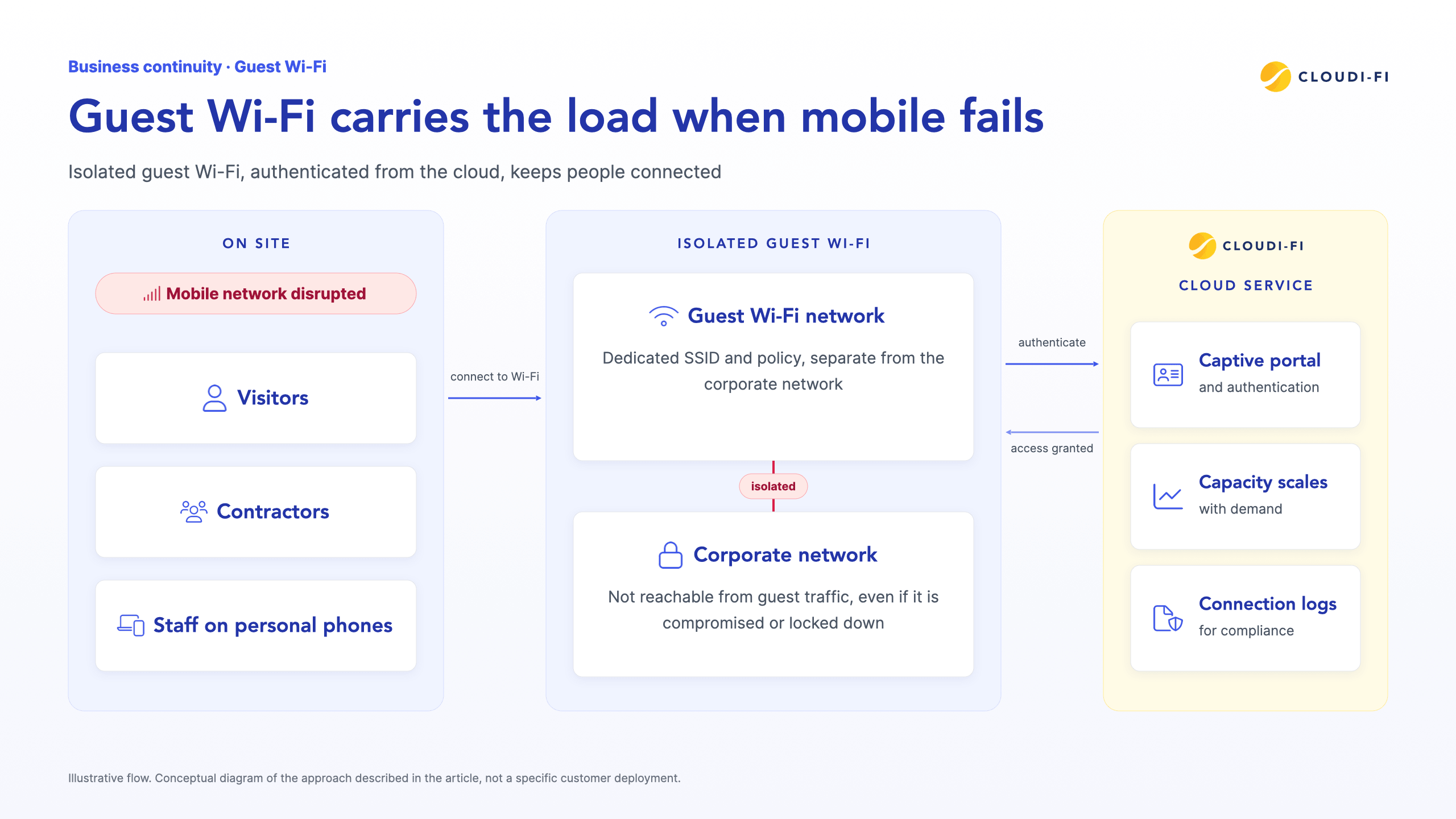
Visitors, contractors, and staff on personal phones all need a connection when mobile data is gone. Employees need it for messaging, payments, and authentication apps. Visitors need it to reach anyone at all.
A guest network that is separate from the corporate network does two jobs. It gives people a working path to the internet, and it keeps that path away from internal systems. Customers describe the second point regularly: when the corporate network is compromised or locked down, an isolated guest network can remain a lifeline. Because guest traffic cannot reach corporate resources, it can stay available while the corporate side is investigated or restored.
The cost of losing connectivity is high. ITIC's 2024 Hourly Cost of Downtime Survey found that a single hour of downtime costs more than $300,000 for over 90% of mid-size and large enterprises, and 41% of enterprises put it between $1 million and more than $5 million (ITIC, September 3, 2024).
Backup connectivity has to absorb the surge
Backup capacity tends to fail in one specific way: it is sized for a regular day. When mobile data disappears, everyone arrives at the same time.
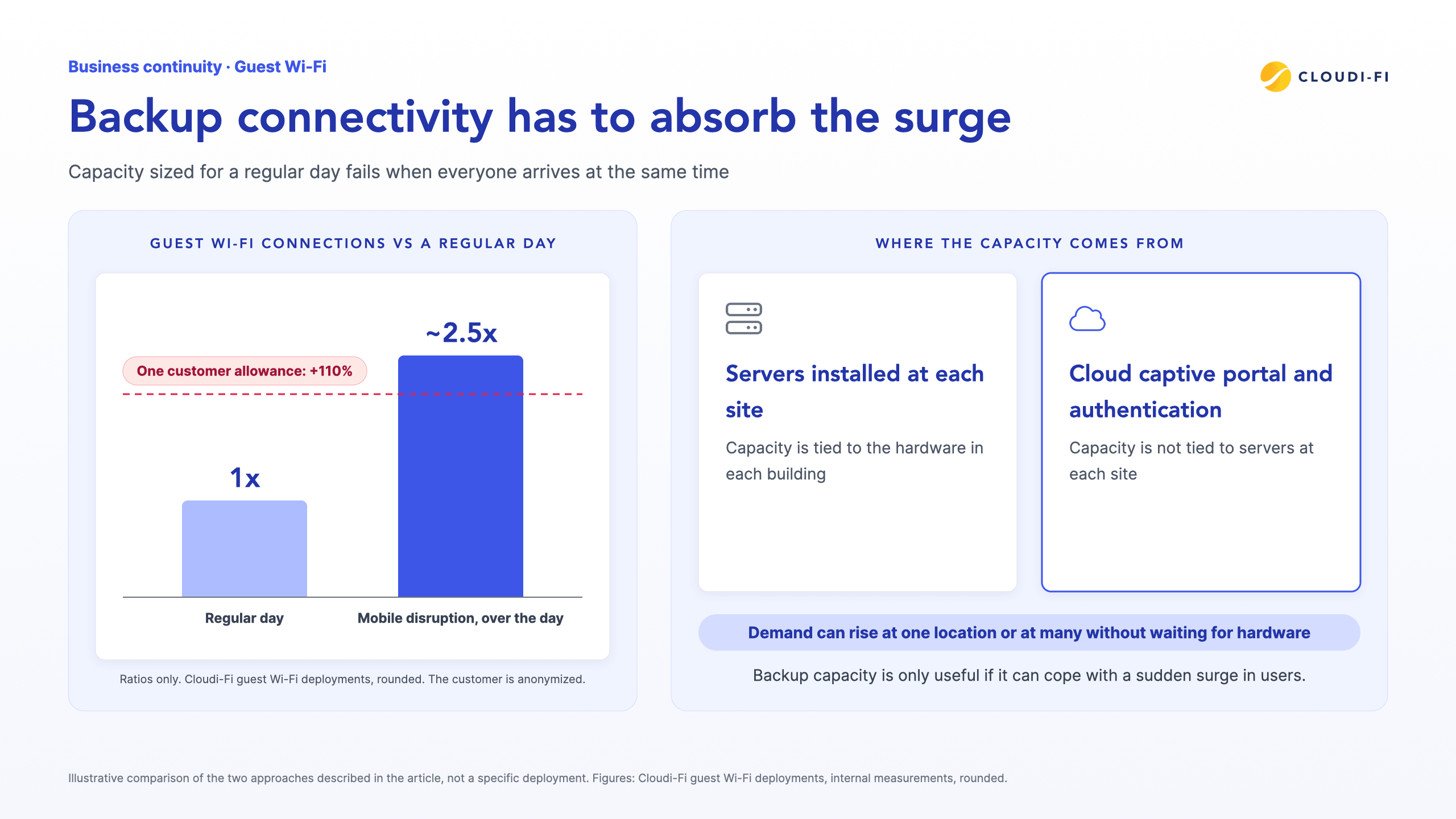
During the recent mobile disruption, connections across Cloudi-Fi guest Wi-Fi deployments reached almost 2.5 times the level of a regular day over the day, and more over shorter periods, with the rise almost immediate at a time when traffic usually eases. The platform kept running.
Capacity is also a matter of contract and configuration. One large retail customer had a usage allowance of 110% extra on top of its plan. A rise of about 150% was above that allowance, so some of its guests were blocked. Headroom has to be planned in the platform and in the allowance set for each site.
This is where cloud scalability makes a real difference. Cloudi-Fi runs the captive portal and authentication as a cloud-native service, so capacity is not tied to servers installed at each site. Demand can rise at one location or at many without waiting for hardware.
What to check in a guest Wi-Fi setup
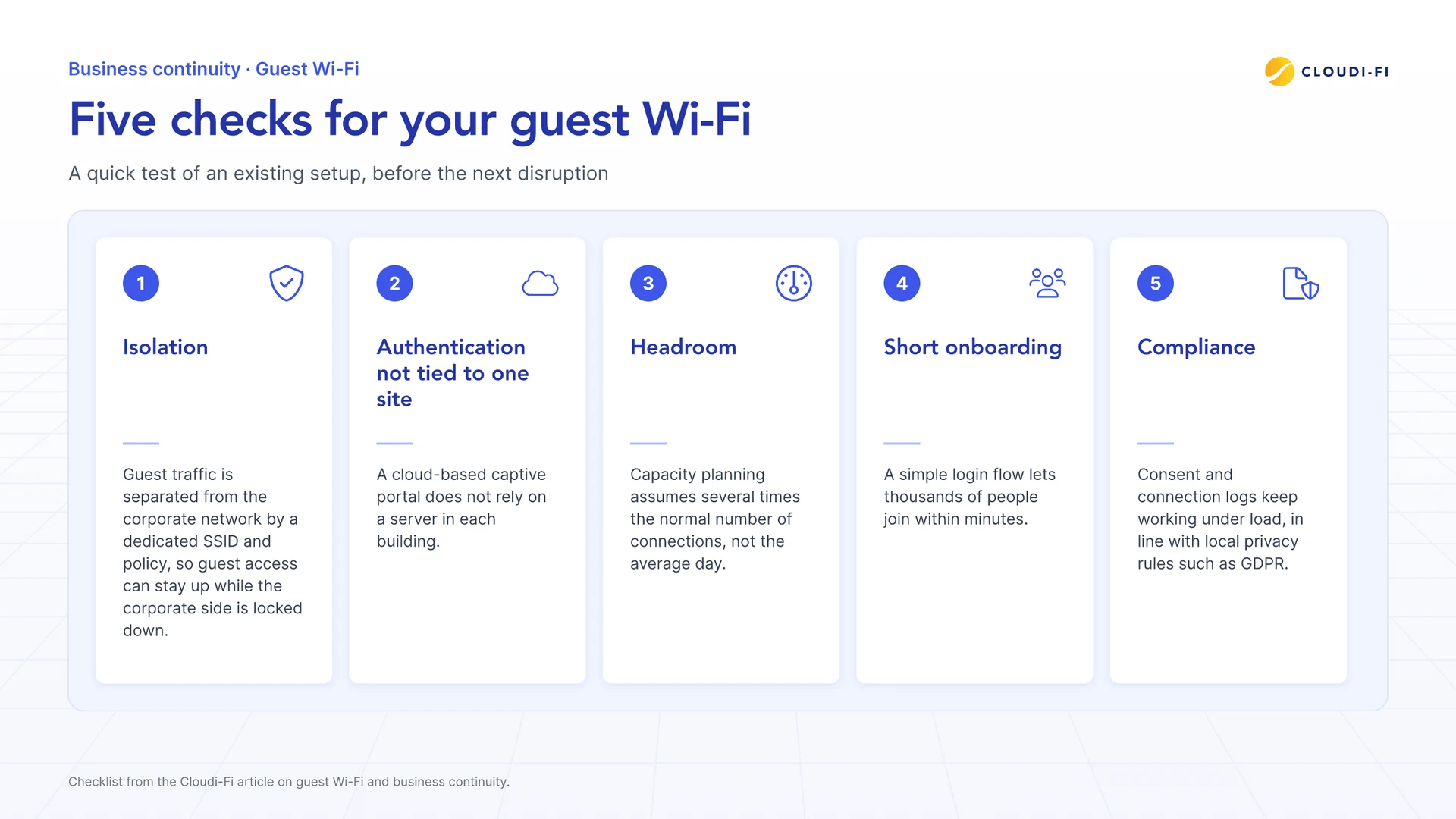
Network teams can test their own guest Wi-Fi against five points:
- Isolation: Guest traffic is separated from the corporate network by a dedicated SSID and policy, so guest access can stay up while the corporate side is locked down.
- Authentication that does not depend on one site: A cloud-based captive portal does not rely on a server in each building.
- Headroom: Capacity planning, and the usage allowance in each plan, assume several times the normal number of connections, not the average day.
- Short onboarding: A simple login flow lets thousands of people join within minutes.
- Compliance: Consent and connection logs keep working under load, in line with local privacy rules such as GDPR.
Guest Wi-Fi is no longer a commodity
For years, guest Wi-Fi was treated as a courtesy. It now belongs in the business continuity plan. It keeps visitors and staff connected when mobile coverage fails, it stays separate from internal systems, and it has to scale when demand spikes.
Explore Cloudi-Fi Captive Portal to see how an isolated, cloud-scalable guest network works.
Related reading: Top 13 guest Wi-Fi security best practices and How cloud NAC enhances Zero Trust for multi-site enterprises.