
In the modern business landscape, the question is no longer "Should we offer Wi-Fi?" but rather "How can we make our Wi-Fi work for us?" Whether you are a boutique coffee shop or a multi-national conglomerate with offices on five continents, providing internet access to visitors is no longer a luxury, it is a baseline expectation.
However, simply handing out a sticky note with a WPA2 password scribbled on it is a relic of the past. Today, a Guest Wi-Fi network is a sophisticated tool for security, branding, and data analytics.
At Cloudi-Fi, we’ve seen the transition from simple connectivity to complex, cloud-managed experiences. How do you manage your Guest Wi-Fi? Are you following the prerequisites? Let’s get into it!
What is Guest Wi-Fi ?
At its most basic level, a Guest Wi-Fi network is a dedicated SSID on a wireless network intended specifically for visitors, contractors, and customers. It is designed to provide internet access while keeping these external users completely isolated from the company’s internal network, servers, and sensitive data.
The evolution of the Guest network
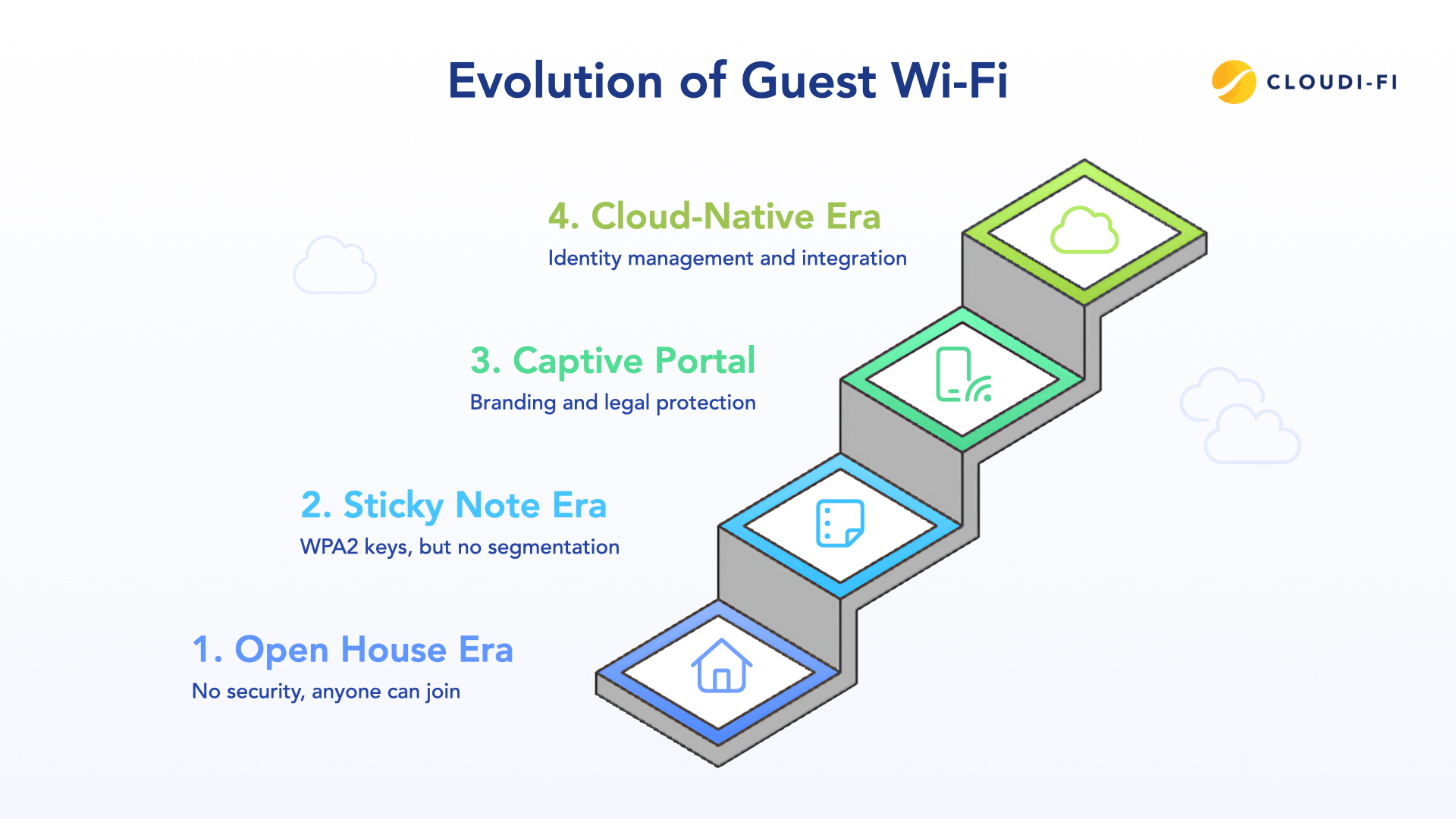
The concept of guest access has undergone a massive transformation over the last two decades. Understanding this evolution is key to realizing why modern solutions are so critical.
- The "Open House" Era (Early 2000s): In the early days, if a business offered Wi-Fi, it was often "open." Anyone within range could join. There was no security, no segmentation, and no visibility. It was the digital equivalent of leaving your front door wide open and hoping no one stole the TV.
- The "Sticky Note" Era (2010s): As security awareness grew, businesses began using WPA2-Personal keys. You’d walk into a lobby and see the password printed on a sign. While this kept "drive-by" hackers out, it did nothing to segment the network. If a guest’s laptop was infected with malware, it could easily jump to the company’s local file server.
- The "Captive Portal" Era (Mid-2010s): Businesses realized they could use the login process for branding. Captive portals became standard. This added a layer of legal protection and a touch of professional branding.
- The "Cloud-Native & Intelligence" Era (Present Day): Today, Guest Wi-Fi is managed in the cloud. It is no longer just about "getting online." It is about identity management, compliance (GDPR/LGPD), marketing automation, and seamless integration with vendors or CRM systems. This is where Cloudi-Fi lives, transforming a utility into a strategic asset.
The benefits: Why Guest Wi-Fi is a non-negotiable asset
Why should a company invest time and resources into a dedicated Guest Wi-Fi management system? The benefits span across security, operational efficiency, and marketing.
The security buffer
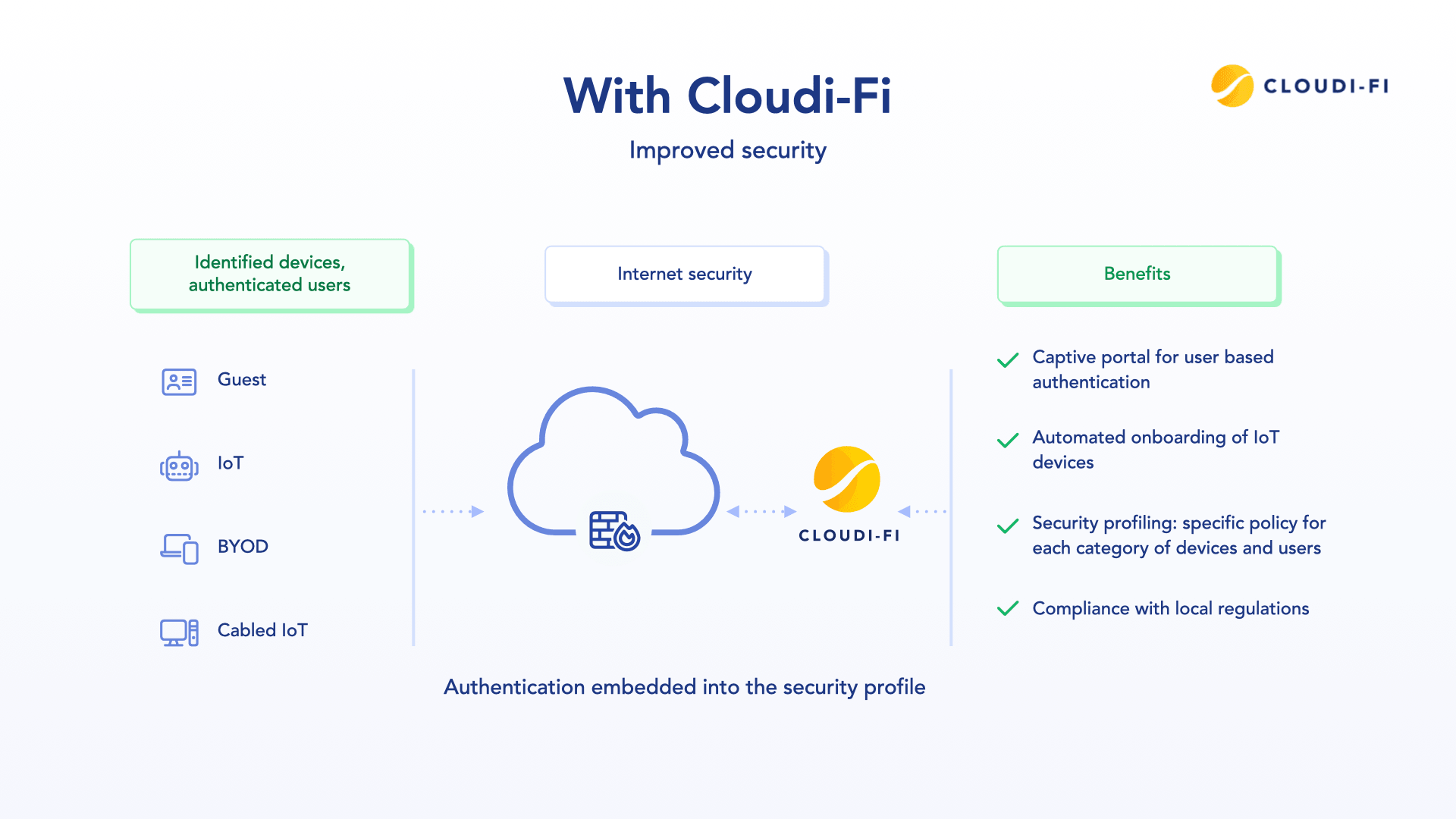
The primary role of a Guest Wi-Fi network is segmentation.
By creating a "walled garden" for guests, you ensure that even if a visitor’s device is compromised, they have no path to your internal infrastructure. A guest should never be on the same VLAN as your HR records, financial data, or R&D blueprints.
Scalability across the business spectrum
The utility of Guest Wi-Fi scales perfectly with the size of the organization:
Compliance and legal protection
In many jurisdictions, businesses are legally responsible for the activity occurring on their networks. If a guest performs illegal downloads on your "open" Wi-Fi, the liability could fall on the business. Modern Guest Wi-Fi solutions log identities (without infringing on privacy) to ensure that the business is protected and compliant with local regulations like GDPR in Europe.
How Cloudi-Fi revolutionizes utilization
While traditional Guest Wi-Fi required expensive on-site controllers and complex configurations, Cloudi-Fi has flipped the script as a 100% cloud-based solution.
- Hardware agnostic: Cloudi-Fi works with your existing infrastructure (Cisco, Aruba, Meraki, etc.). You don't need to rip and replace your hardware to get enterprise-grade features.
- Zero-Touch deployment: For global
enterprises, managing Wi-Fi across50 countries is a nightmare. Cloudi-Fi allows for centralized policy management. Change a portal design in New York, and it updates in London and Tokyo instantly. - Personalized experience: Instead of a generic "Welcome" page, Cloudi-Fi uses data to personalize the experience. If a returning customer logs in, the system recognizes them, providing a seamless "Hello again!" experience that builds brand affinity.
Implementation: Prerequisites and action plan
Implementing a Guest Wi-Fi network might seem daunting, but with a structured approach, it can be rolled out smoothly without disrupting your daily operations.
The prerequisites
Before you flip the switch, ensure you have the following in place:
- Sufficient bandwidth: Guest traffic should not throttle your employees' Zoom calls. Ensure your ISP provides enough "overhead" or implement Rate Limiting (QoS) for guests.
- A Cloud management platform: To move beyond the "sticky note" phase, a platform like Cloudi-Fi is required to manage the captive portal, authentication, and logs.
- Defined access policies: Decide how guests will log in. Will they use social media, email, or a sponsored "one-click" approval from an employee?
- Marketing assets: The desired captive portal may look the same as your company colors and fonts. Make sure to have the appropriate assets to build the captive portal.
The implementation action plan
Step 1: Network design & segmentation
Create a dedicated VLAN for guest traffic. This ensures that guest data packets are physically or logically separated from corporate data packets at the router level. Configure your firewall to allow guest traffic out to the internet but block all traffic directed toward internal subnets.
Step 2: Configure the captive portal
This is your digital lobby. The portal should:
- Be mobile-responsive (most guests connect via smartphone).
- Reflect your brand (logo, colors, tone of voice).
- Include a clear Terms of Service (ToS) checkbox to mitigate legal risks.
Step 3: Integration and authentication
Connect your Wi-Fi infrastructure to your Guest Management solution. If you are using Cloudi-Fi, this is typically done via an API or a simple redirect configuration. This is also where you integrate your CRM so that guest data can flow directly into your marketing funnel.
Step 4: Testing and quality assurance
Do not skip this. Test the network from various devices (iOS, Android, Windows, macOS). Check the range of the signal in common guest areas like lobbies, breakrooms, and conference halls. Ensure the "handover" between access points is seamless.
Step 5: Launch and monitor
Once live, monitor the usage. Are people dropping off at the portal? Is the bandwidth being abused? Use the analytics provided by your cloud dashboard to tweak the experience over time.

Conclusion
A Guest Wi-Fi network is no longer a simple "plug-and-play" utility; it is a critical intersection of security, compliance, and marketing. We’ve evolved from the dangerous days of open networks to a world where cloud-based solutions provide seamless, secure, and branded experiences for every visitor who walks through your door.
By implementing a robust Guest Wi-Fi strategy, you protect your company’s internal assets, satisfy legal requirements, and provide a value-added service to your guests. Whether you are managing a single storefront or a global enterprise, the move to a cloud-managed system like Cloudi-Fi ensures your network is future-proof, scalable, and secure.
Ready to transform your visitor's digital experience and secure your network with ease?