
Enterprise networks are undergoing a fundamental transformation and with it, the security models. Zero Trust, SASE, and cloud-managed connectivity have become the new standard for securing users and applications. Yet, despite these advances, one critical gap remains largely unresolved: unmanaged users and devices such as BYOD, Guest Wi-Fi users and IoT.
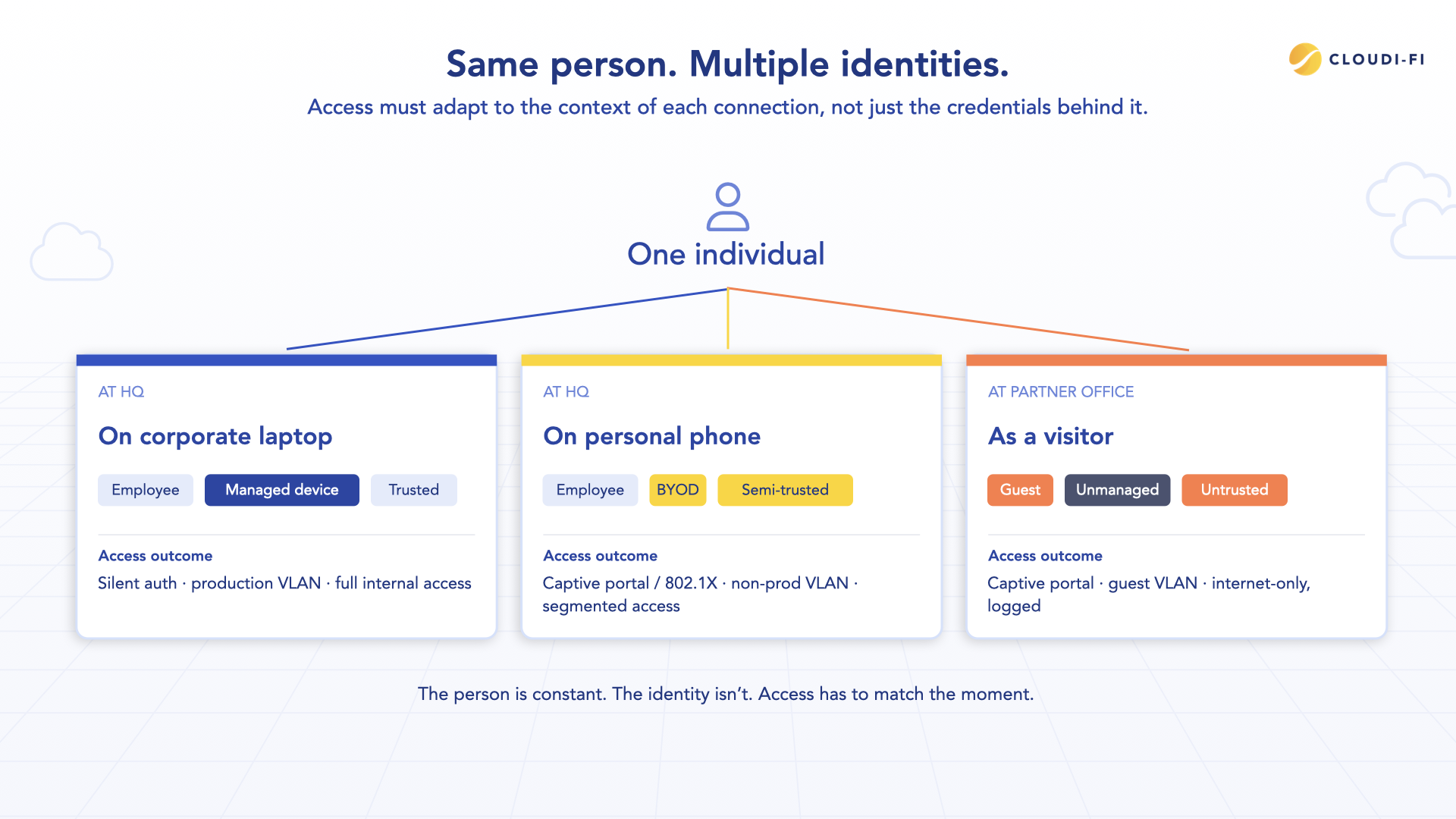
At the same time, a single individual can embody multiple identities: an employee using a corporate laptop, the same employee accessing the network from a personal device, or that individual acting as a guest in another location. Traditional access models struggle to represent this reality.
This creates a paradox:
Some of the most common connection types are also the least understood and least controlled.
The hidden security and compliance risk of unmanaged devices
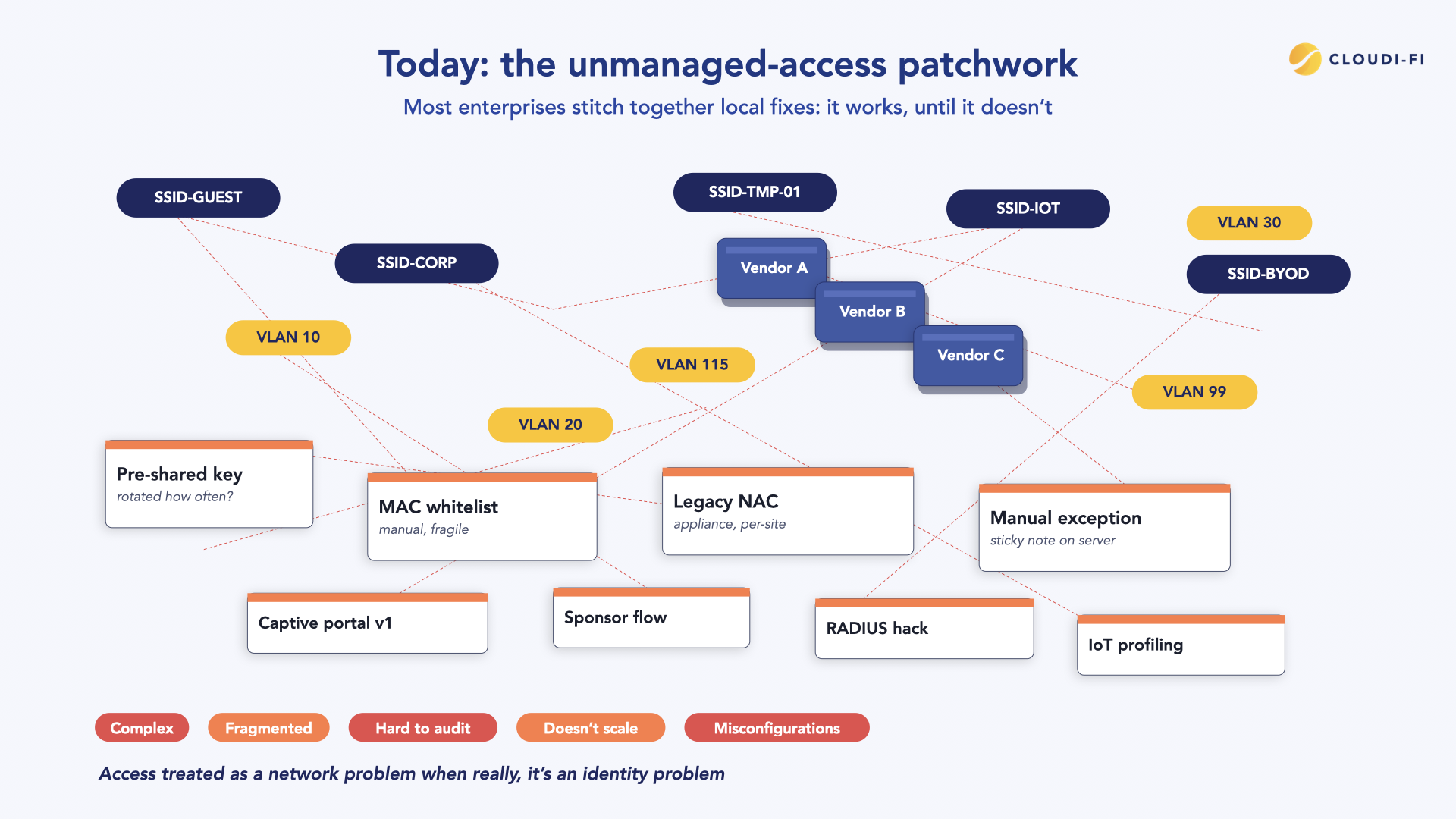
In most enterprises, unmanaged access is handled through a patchwork of approaches:
- Multiple SSIDs and VLAN sprawl
- Pre-shared keys or MAC address whitelisting
- Legacy NAC deployments that struggle to scale
- The stacking of multiple, loosely integrated solutions and vendors
- Manual exceptions layered on top of modern architectures
While these approaches may work locally, they don’t scale globally. They introduce operational complexity, increase the risk of misconfiguration, and make compliance and auditing far more difficult than they need to be.
More importantly, they treat access as a network problem when in reality it is an identity problem.
Why identity still matters — even without corporate credentials
Zero Trust teaches us that access should be based on identity and trust, not location. But what happens when a device has no corporate identity to begin with?
A guest’s phone, an employee’s personal laptop, or a smart camera in a factory doesn’t authenticate against Active Directory or central databases. Yet these devices still need:
- Controlled access
- Appropriate segmentation
- Logged and auditable activity
- Integration with existing security policies
The missing piece isn’t another SSID or VLAN.
It’s identity — even if that identity is contextual, temporary, or non-corporate.
One network, multiple identities
A more modern approach starts with a simple principle:
The physical network should be shared. Access outcomes should not be.
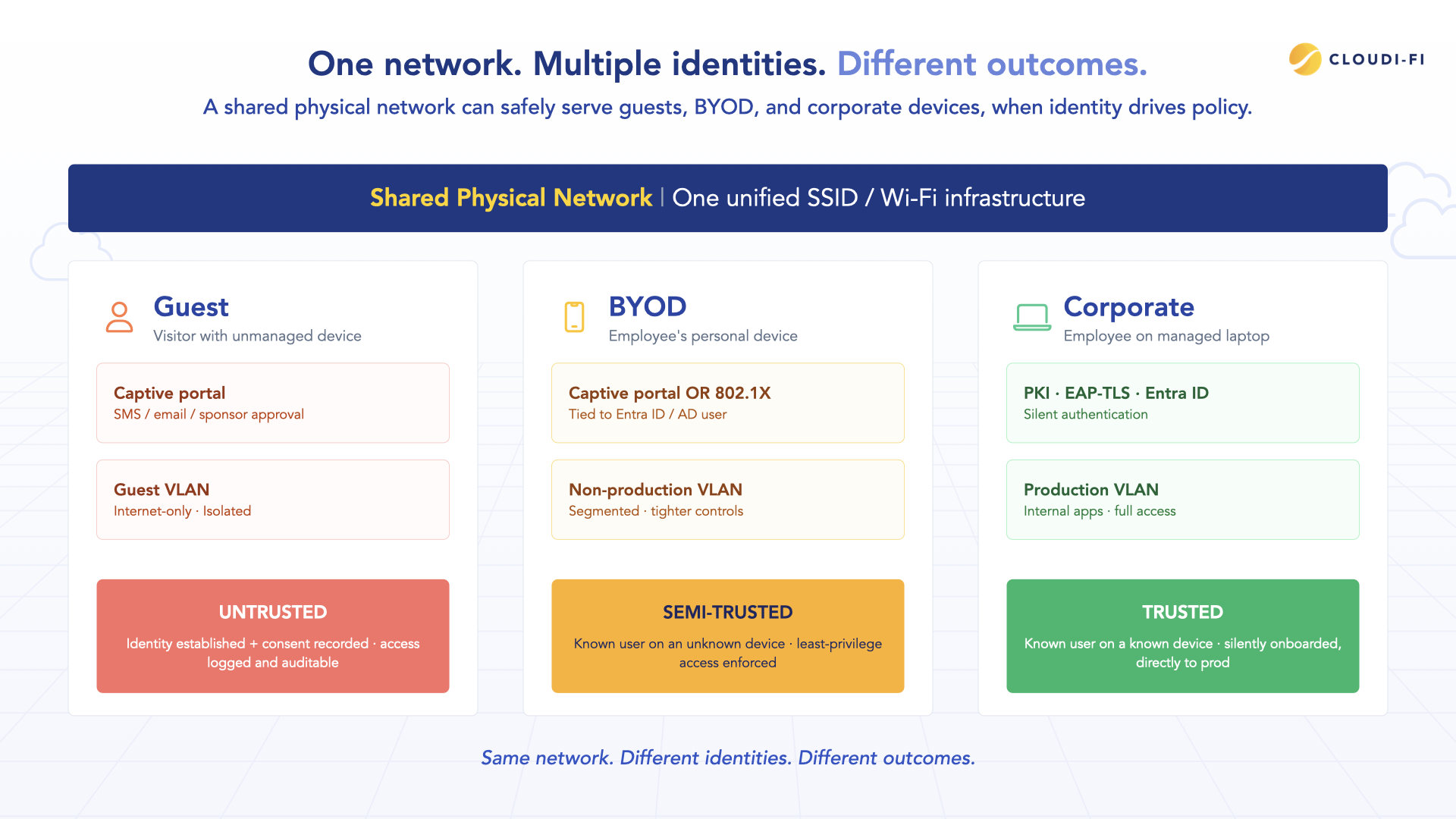
On a single network or unified SSID, different users and devices can coexist — as long as identity determines trust and policy.
Consider three common scenarios:
Guest users
A visitor arrives with an unmanaged device. They authenticate through a captive portal using SMS, email, or sponsor approval. Their identity is established, consent is recorded, and access is logged. They are placed on a Guest VLAN with internet-only access, fully compliant and auditable.
Corporate-managed devices
An employee connects using a corporate-issued laptop. Authentication happens via PKI or Entra ID. No captive portal is required. The device and user are recognized as trusted and are placed directly on a production VLAN with access to internal applications.
Employee BYOD
An employee’s personal device sits somewhere in between. It can authenticate through a captive portal or via NAC and 802.1X. It is intentionally treated as semi-trusted and placed on a non-production VLAN, with segmented access and tighter controls.
In all three cases, the network remains the same. What changes is the identity, trust level, and resulting policy.
From network control to identity-driven access
This shift reframes how we think about access control:
- VLANs become enforcement tools, not decision points
- SSIDs become onboarding mechanisms, not security boundaries
- Identity becomes the primary driver of trust and segmentation
Rather than bolting security onto connectivity, identity is introduced at the moment of access — even for users and devices that don’t belong to corporate IAM.
Why this matters for managed and global environments
For global enterprises and managed service providers, this model is especially powerful:
- It reduces operational complexity
- It scales across regions and regulatory environments
- It aligns unmanaged access with Zero Trust principles
- It integrates cleanly with existing security stacks
Most importantly, it allows organizations to extend Zero Trust beyond employees, without redesigning their networks from scratch.
Building a future-ready Zero Trust network?
Implementing Zero Trust across modern Wi-Fi environments requires coordinated identity verification, secure onboarding, segmentation, and continuous policy enforcement across users, devices, and locations.
Download our ZTNA Implementation Checklist to evaluate your network access architecture, identify security gaps, and structure a scalable Zero Trust deployment strategy.
Rethinking the edge of the enterprise
As enterprises decentralize, Guests, BYOD, and IoT devices have become a permanent part of the network edge.
The real challenge is no longer connectivity, but intelligent identity and access control.
The future of access is not about building more networks — it’s about making identity the common language across all environments.
It’s about making identity the common language across all of them.
A shift already underway
The industry is gradually moving toward an access model where identity is no longer limited to employees or managed devices. Guests, BYOD, and IoT are becoming first-class citizens in enterprise networks — not because they are trusted, but because they must be understood, segmented, and governed.
Authenticate Guests, BYOD and IoT devices with Zscaler.
This shift requires rethinking how access is delivered. Instead of adding complexity at the network layer, organizations are beginning to externalize identity, onboarding, and compliance, allowing access decisions to be made dynamically and consistently across environments.
Cloud-native platforms such as Cloudi-Fi reflect this evolution. By focusing on identity and policy rather than infrastructure control, they illustrate how Zero Trust principles can be extended beyond traditional boundaries — without forcing enterprises or service providers to redesign their networks.
FAQ
What are unmanaged devices in an enterprise network?
Unmanaged devices are endpoints that connect to the corporate network without being enrolled in the organization's device management or security stack — typically personal phones and laptops, contractor equipment, printers, cameras, and IoT systems like badge readers or smart sensors.
How do enterprises secure unmanaged devices?
They secure them by isolating them on dedicated network segments, authenticating them through methods such as captive portals, sponsor approval, or MAC-based profiling, and limiting their access to only the resources they truly need through identity-driven NAC policies.
How does Zero Trust apply to Guest Wi-Fi?
Zero Trust treats every guest connection as untrusted by default — verifying identity or session context at login, isolating guest traffic from internal resources, and enforcing least-privilege access for the duration of the session rather than granting implicit trust once the device is on the network.
How is identity-driven NAC different from traditional NAC?
Identity-driven NAC makes access decisions based on who the user is and the context of their device, while traditional NAC relies primarily on network attributes like ports, MAC addresses, and VLANs, with identity treated as a secondary input rather than the primary one.