

A consistent welcome for every visitor. Local control over access, consent, and authentication-log retention.
Global guest Wi-Fi should reflect the same organization across all locations. Visitors should recognize the brand and find a clear path to internet access, whether they arrive at headquarters, a regional office, or a retail branch.
That consistency does not require identical policies everywhere. Language, authentication choices, privacy notices, and data-handling requirements can differ by country. Cloudi-Fi brings guest Wi-Fi management into one platform while supporting the local configurations each deployment requires.
The challenge with a single worldwide policy
Multinational IT teams often face two imperfect options. Independent local portals accommodate regional needs but create fragmented branding and administration. A single rigid configuration is easier to standardize but can overlook differences in local requirements.
The real work is deciding which elements stay common everywhere and which need local review.
- Brand identity and the overall guest experience should remain recognizable
- Authentication methods should reflect the site's access requirements
- Notices and consent flows should reflect approved local wording
- Authentication-log retention should account for the location's country
A global guest Wi-Fi service needs both a shared operating model and clearly defined local policies.

How it works with Cloudi-Fi
Keep the guest experience consistent
The Cloudi-Fi Captive Portal supports branded login pages and configurable access flows. Each location keeps the organization’s visual identity while showing its own notices and registration fields. Portals are multilingual, so visitors in every country see the same brand in their own language
Guests recognize the same brand in every country, even when the form or sign-in method changes.
Configure access for each site
Centralized guest Wi-Fi management lets IT teams manage authentication methods, access rules, and who connected, where, and how they signed in across locations. Supported onboarding options include sponsored access, SMS verification, and email registration, configured according to the site's needs.
An office might require an employee to sponsor each visitor, while a retail site offers a quicker registration. Choose the verification level each site needs: SMS confirms a phone number, and email registration captures a contact.

Adapt notices and consent flows
Local legal teams define the notices and consent requirements that apply to the deployment. Cloudi-Fi supports configurable consent flows and opt-in mechanisms so that these requirements can be reflected in the guest journey.
Terms of use, privacy notices, and optional marketing permissions need distinct treatment. Each country can present its own approved terms, privacy notice, and marketing opt-in.
Apply country-based authentication-log retention
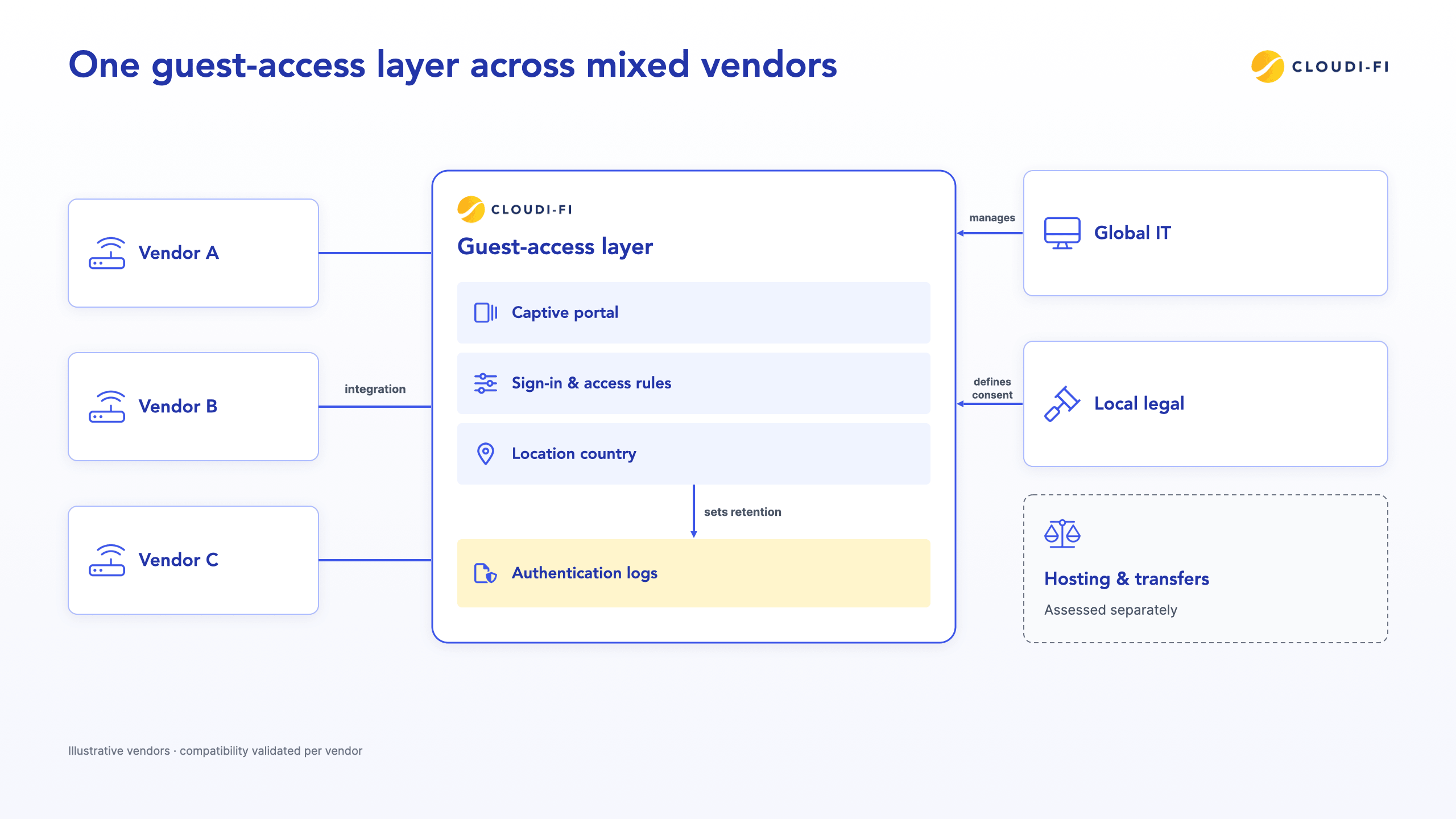
Cloudi-Fi’s published guidance ties authentication-log retention to the country configured for each location. Keeping that country setting accurate ensures the service automatically applies the corresponding retention policy.
Retention follows the location's country. Hosting locations and international transfers are a separate topic, covered on our data privacy compliance page. Data privacy compliance capabilities give legal teams the controls to put their assessment into practice.
Work across existing infrastructure
A multinational may operate different network vendors across its estate. Cloudi-Fi supports integrations with existing infrastructure, helping establish a common guest-access management layer across supported environments.
Compatibility and enforcement are validated for each vendor during deployment planning. One guest-access layer across a mixed-vendor estate.
Compatibility and enforcement requirements should be validated for each deployment rather than assumed to be identical across vendors.
What this looks like in practice
Consider a multinational with offices and customer-facing locations in several countries. This is an illustrative scenario, not a customer case study.
The organization uses a common visual identity across its portals. Office visitors request sponsored access, while selected customer-facing sites offer a shorter registration flow. Each location presents the approved language and legal content, and its configured country informs authentication-log retention.
Global IT runs the service from one console and applies the requirements approved for each country. Adding a site means reusing the existing model, not starting a new guest Wi-Fi project.
The operational outcomes
This approach is designed to deliver:
- A recognizable guest experience across countries and locations
- One view of guest connections and site configurations across every country
- Local adaptation without separate management platforms for every country
- A clearer division of responsibility between IT, security, and legal teams
- A repeatable deployment model for additional sites
A country-specific policy is not a data-residency guarantee. Hosting locations, international transfers, and applicable service coverage must be assessed separately.
Build a global guest Wi-Fi service around local requirements
Cloudi-Fi helps multinational organizations bring guest access into a common management platform while accommodating differences between locations.
Discuss a global guest Wi-Fi deployment.