

Eleven questions security and network leaders ask about identity-driven Network Access Control — and how Cloudi-Fi answers them.
Network Access Control has quietly become one of the most consequential controls in the enterprise. It decides, in real time, who and what is allowed onto the corporate network at every office, factory, and warehouse the business operates. Done well, it is the foundation of segmentation, Zero Trust, and passwordless access. Done poorly, it becomes a fragile, labor-intensive layer that slows the rest of the security program down.
The conversation around NAC has shifted. Security teams want stronger controls. Network teams want less operational overhead. IT leadership wants predictable cost and faster rollouts at every corporate site. Cloudi-Fi was built for exactly that conversation — an identity-driven, cloud-native NAC that delivers the same proven foundations the industry relies on, but without the appliance sprawl that has defined NAC for the past two decades.
Below are eleven of the questions we hear most often from CISOs, network architects, and infrastructure leaders, with direct answers about how Cloudi-Fi’s approach works in practice.
NAC is no longer a checkbox. It is the control plane that decides, in real time, who and what belongs on the corporate network.
Q1. What is Network Access Control, and why is it being rethought now?
ANSWER
At its core, NAC is about ensuring that only the right users and devices are allowed onto the corporate network at a corporate location — an office, a factory, a warehouse — and that they receive the appropriate level of access based on who they are and the context of their connection. The idea is straightforward; the operating reality, in most enterprises, has not been.
NAC is being rethought now because the assumptions underneath the original designs no longer hold. Corporate sites have multiplied. Contractors, vendors, and visitors are on site every day. And the security model has shifted toward identity-driven, Zero Trust principles that the legacy NAC architecture was never designed to deliver. Modernizing NAC is what makes the rest of that architecture work at the network layer.
Q2. What is wrong with the way NAC has traditionally been delivered?
ANSWER
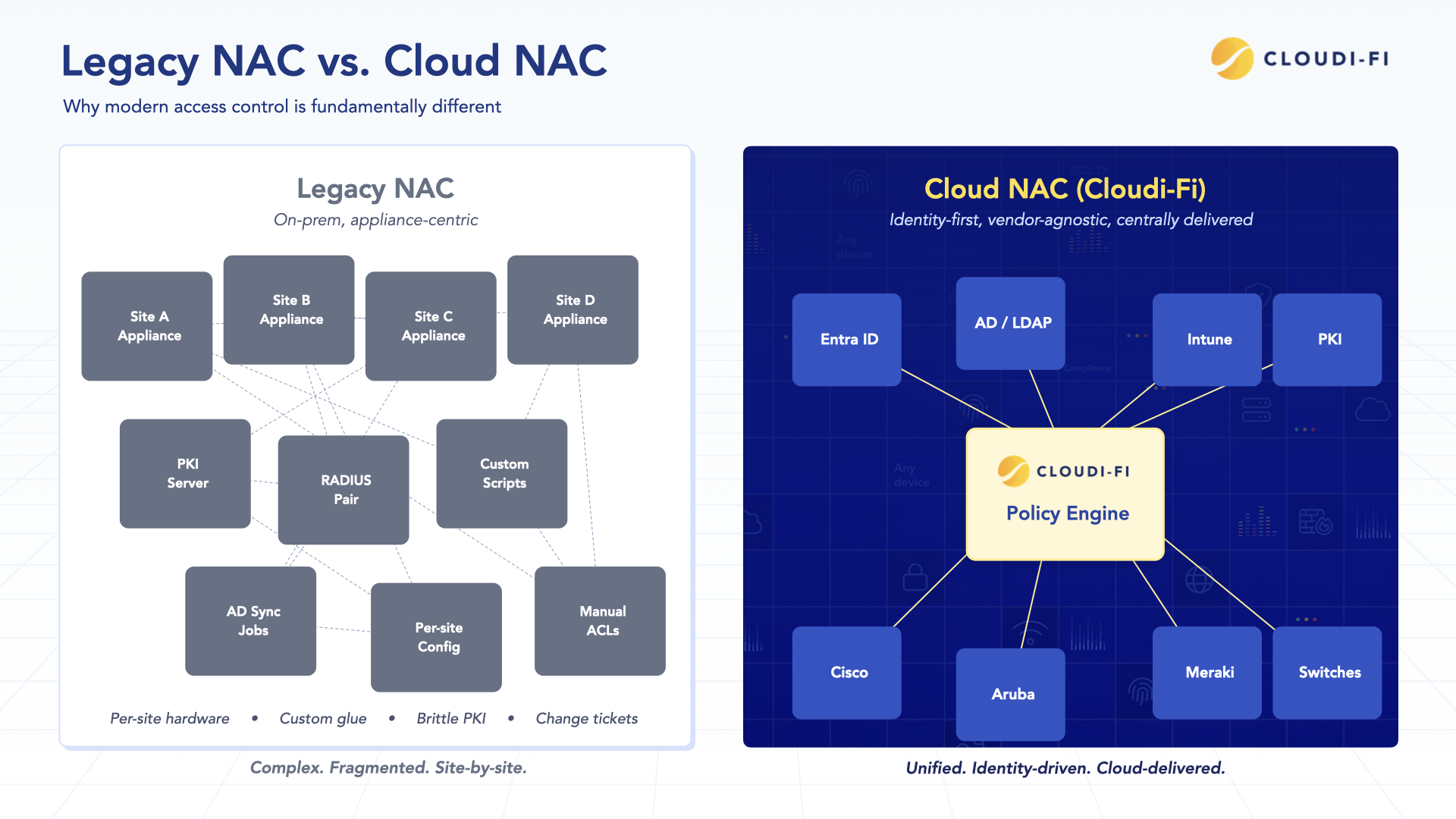
Traditional NAC was designed for a world where users worked in offices, devices were corporate-owned, and the network perimeter was a physical boundary. That world is gone, but many organizations still carry the operational weight of that era: dedicated hardware in every site, redundant pairs to manage, complex PKI setups to maintain, and policy changes that require coordination across multiple teams.
The result is a paradox. The same platforms that were meant to simplify access control end up becoming one of the most fragile and labor-intensive elements of the network. Scaling to a new site becomes a project. Onboarding a new identity provider becomes a project. Even a small policy change can feel like one. Security teams want stronger controls. Network teams want less operational overhead. IT leadership wants predictable cost and faster rollouts. Legacy NAC forces a trade-off between those goals. A cloud-native, identity-driven approach removes it.
Q3. What does “identity-driven NAC” actually mean in practice?
ANSWER
It means that the primary signal used to make a network access decision is the verified identity of the user or device, not the physical port or the MAC address. A laptop plugged into a conference-room jack might belong to a full-time employee, a contractor on a short-term project, or a visitor who should only see the internet. The network has no way of telling them apart without identity.
Cloudi-Fi’s NAC is built around identity as the primary signal. Every authentication event is tied to a verified user or device, and every authorization decision is informed by the attributes of that identity — department, role, group membership, certificate validity, the SSID or port the connection arrived on. The question shifts from “where is this device plugged in?” to “who is this, and what should they be allowed to reach?”
The shift is from “where is this device plugged in?” to “who is this, and what should they be allowed to reach?”
Q4. How does Cloudi-Fi authenticate users and devices?
ANSWER
Cloudi-Fi supports the authentication standards security teams already rely on. The platform implements 802.1X for both wired and wireless access, with full support for certificate-based authentication through EAP-TLS. That enables a strong, passwordless security model in which devices authenticate using cryptographic identity rather than shared secrets that can be phished, reused, or leaked.
For organizations not yet ready to move to certificates everywhere, Cloudi-Fi also supports credential-based flows, captive portals for guests and visitors, and MAC authentication bypass for headless devices. The goal is not to force a single approach — it is to give each class of user and device the strongest method it can reasonably support at every corporate site.
Q5. How does Cloudi-Fi work with our existing identity providers?
ANSWER
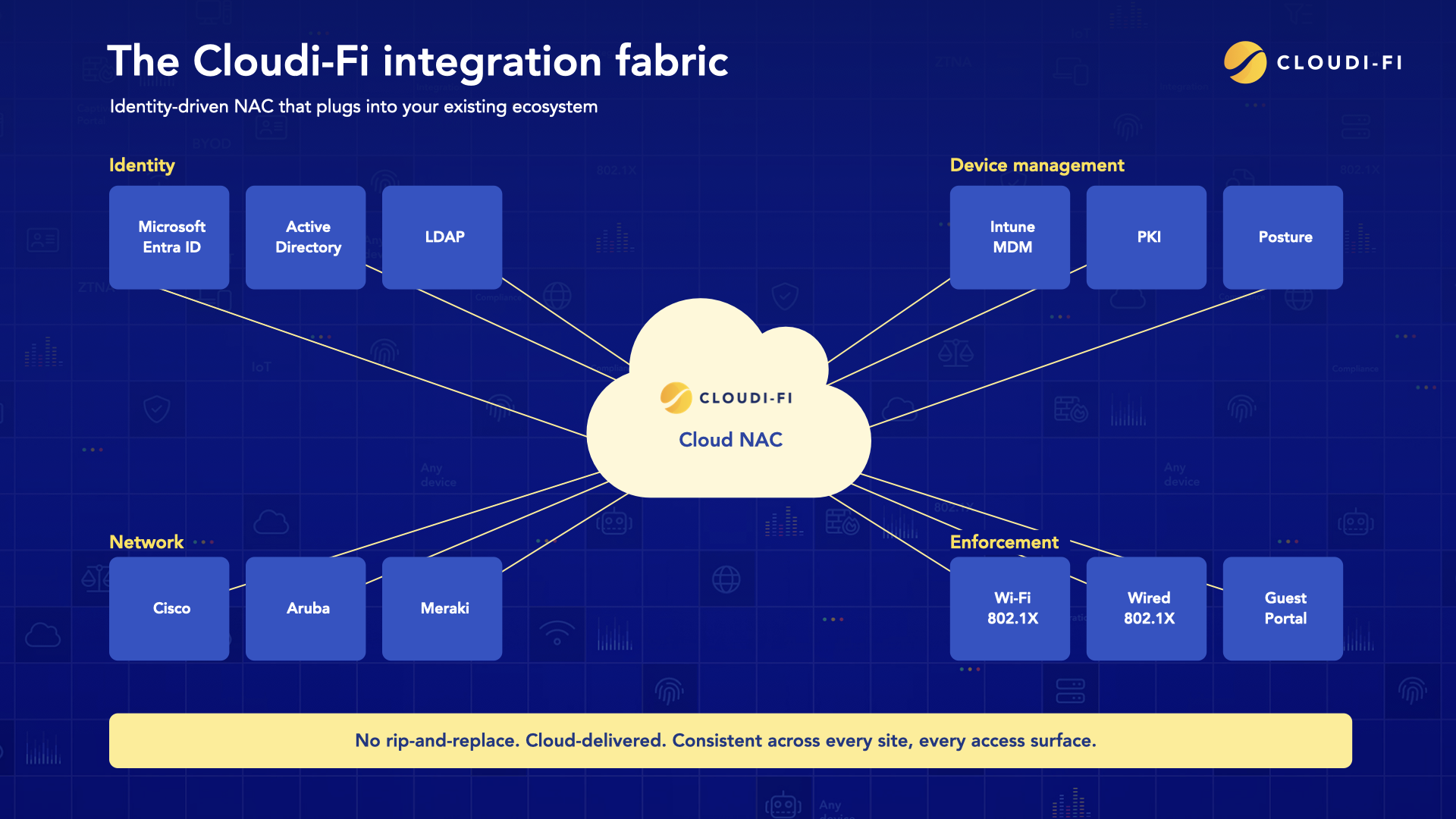
Cloudi-Fi integrates directly with the identity systems the organization already uses. That includes Microsoft Entra ID for cloud-first environments, as well as traditional LDAP and Active Directory deployments. Group memberships, user attributes, flow into access decisions automatically, so changes in the directory are reflected at the network layer without a separate administrative process.
This integration matters for more than convenience. When network access policies are driven by the same directory that governs applications, SaaS, and email, the organization gains a single, consistent definition of who a user is and what they are entitled to — at every corporate location they walk into.
Q6. Do we need to rip and replace our existing network equipment?
ANSWER
No. Cloudi-Fi operates as a cloud-delivered RADIUS-based policy engine. Authentication and authorization decisions are centralized in the cloud, but enforcement happens exactly where it always has — on the switches, access points, and controllers already deployed in the environment. The platform works with major network vendors, whether the infrastructure is built on Aruba, Cisco, or a mix of others.
NAC modernization should not require a forklift upgrade of the network. Organizations can adopt Cloudi-Fi without replacing the equipment they already trust, and without asking their teams to learn a new set of vendor-specific tooling for everyday operations.
Q7. How does Cloudi-Fi coexist with an existing NAC like Cisco ISE or Aruba ClearPass?
ANSWER
Cloudi-Fi does not coexist with another NAC on the same enforcement point — and that is a deliberate, architecturally honest answer. A Cisco switch (or any access switch) can only point its 802.1X / MAB requests at one kind of RADIUS server at a time. It is either pointed at the legacy NAC or at Cloudi-Fi. There is no clean “run both in parallel” mode on a single switch.
What Cloudi-Fi does support is a phased migration — site by site, SSID by SSID, or VLAN by VLAN. A pilot site re-points its switches and SSIDs to Cloudi-Fi while the rest of the estate continues to authenticate against the incumbent. As confidence grows, additional sites are cut over on a planned schedule. Throughout, the IdP, directory, certificate authority, and the existing network hardware stay exactly where they are. The migration is a re-pointing exercise, not a forklift, and the incumbent is decommissioned once the last site has moved.
Q8. How is access actually enforced once a device is authenticated?
ANSWER
Once a user or device is authenticated, Cloudi-Fi enforces access through dynamic VLAN assignment and role-based access driven by identity attributes returned in the RADIUS response. Employees land in the segment appropriate to their role. Contractors receive access limited to the applications and resources they need for their engagement. IoT devices are placed in segments that isolate them from sensitive systems. Guests are routed to an internet-only segment with logged consent.
Because these decisions are made in real time, based on identity and context, segmentation becomes a living policy rather than a static diagram drawn once and quietly drifting out of date.
Q9. What does certificate-first, passwordless onboarding look like?
ANSWER
For organizations pursuing a certificate-first strategy, Cloudi-Fi integrates with the PKI and the mobile device management platform — for example, Microsoft Intune — that the organization already runs. Certificates are provisioned to managed devices automatically, so onboarding a new laptop or phone no longer requires a user to type a password into a connection prompt.
At authentication time, Cloudi-Fi validates that the device is presenting a valid certificate issued by the trusted CA and bound to the managed endpoint. It does not consume runtime telemetry from MDM or EDR agents to make the access decision — the cryptographic identity itself, combined with the user’s directory attributes, is what drives the outcome. The benefits compound: fewer prompts, fewer failed connections, fewer help-desk tickets, and a primary authentication factor that cannot be phished out of a user.
Q10. How does Cloudi-Fi handle wired and wireless together?
ANSWER
Users do not think in terms of wired versus wireless, and access policy should not either. Cloudi-Fi delivers consistent enforcement across both, so a rule written once applies whether a user connects by Wi-Fi in the lobby or by Ethernet in a lab. A single policy fabric governs both transports, with the same identity-driven decisions and the same segmentation outcomes.
This consistency is what makes Zero Trust at the network layer actually feasible. Zero Trust depends on uniform policy regardless of the medium that carries the traffic — and that uniformity is exactly what cloud-delivered, identity-driven NAC is designed to provide.
Q11. What is the business outcome — what changes for security, network, and IT leadership?
ANSWER
Bringing these capabilities together yields a NAC experience that is simultaneously more secure and easier to run. Identity and context replace brittle, network-centric rules. Cloud delivery replaces on-premises appliances and the maintenance burden that comes with them. Integration with existing identity, network, and certificate platforms replaces the custom glue that has historically defined NAC deployments.
For security teams, the result is visibility and control grounded in identity. For network teams, it is a policy engine that speaks RADIUS and respects the hardware already in place. For the business, it is a faster path to segmentation, Zero Trust, and passwordless access at every corporate location — without the multi-year program that those goals have traditionally demanded.
Strong enough for enterprise security requirements. Light enough for the teams that have to live with it every day.
Learn more
Cloudi-Fi’s cloud-native NAC is designed to align network access decisions with user identity and device context at every corporate site, deliver the engine from the cloud, and integrate with the infrastructure the organization already owns. To see how identity-driven access can fit your environment, visit cloudi-fi.com or contact our team for a tailored demo.